
Fast site search: Why milliseconds matter in ecommerce

Fast site search means a shopper sees relevant products within a fraction of a second of typing. It matters because searchers are among the most purchase-ready visitors in an online store, and research on site speed shows that even a tenth of a second changes how many shoppers convert. Every moment between typing and seeing products is a moment a shopper might give up.
Why are searchers worth protecting?
Shoppers who use the search box usually know what they want. Econsultancy reported that visitors who used site search converted at 4.63%, against a site-wide average of 2.77%, roughly 1.8 times higher (Econsultancy, 2013). The data is from 2013, so treat it as a direction rather than a benchmark for your own store. More recent numbers are collected in our ecommerce site search statistics guide.
That intent is what makes the search box a high-stakes moment. A shopper who types “black running shoes size 42” has already done the deciding. What is left is finding the product, and anything that slows that down puts the sale at risk.
What does research say about speed and sales?
Little public research isolates search speed on its own. The strongest evidence comes from studies of site speed, which measure the same thing a searcher experiences: Waiting for products to appear.
| Study | What changed | What happened |
|---|---|---|
| Deloitte for Google (2020), 37 brand sites, 30 million+ sessions | Mobile site 0.1 seconds faster | Retail conversions up 8.4%, average order value up 9.2% |
| Akamai (2017), around 10 billion retail visits | 100-millisecond delay in load time | Conversion rates down by as much as 7% |
| Akamai (2017) | Two-second delay | Bounce rates up 103% |
| Nielsen Norman Group (Nielsen, 1993) | Response within 0.1 seconds | Feels instant to the user |
One detail in the Deloitte study is worth noting. The gains only showed up when every page in the shopping journey got faster (web.dev, 2020). Speed is a property of the whole journey, and search sits right in the middle of it.
Where does search time hide?
A single search involves several waits, and a shopper feels each one:
- Suggestions as you type. They update on every keystroke, so this is the wait shoppers meet most often.
- The results page. The full list of products after pressing enter.
- Filters and sorting. Every click on size, color or price asks for a fresh set of results.
- Mobile connections. Each of the waits above adds up on a phone with a weaker signal.
Nielsen’s three response-time limits give a useful yardstick. About 0.1 seconds is the limit for a response to feel instant, about 1 second is the limit for keeping the user’s flow of thought uninterrupted, and about 10 seconds is the limit for holding their attention (Nielsen Norman Group). Google uses a related yardstick for whole pages: It rates a page’s responsiveness as good when it reacts to clicks, taps and key presses within 200 milliseconds (web.dev). The two measure different things, and both point the same way. The closer a response gets to a tenth of a second, the less the shopper notices the wait.
How fast is Hello Retail Search?
Hello Retail Search returns results in around a tenth of a second, the point where Nielsen Norman Group says a response starts to feel instant. Shoppers who search already know what they want, so every second between typing and seeing products is a second they might give up. Faster results keep them moving: More products seen, more clicks, more chances to add to cart.
The numbers:
- Total search time: Each search takes 100 to 120 milliseconds on a typical day.
- Page-level search time: Around 60 milliseconds on average.
This speed is live on every store running Hello Retail Search, with your setup, design and settings untouched. Nothing to configure, just a quicker path from search to sale. The details are in the changelog.
How can you check your own search experience?
Speed is one part of a search experience that converts. A few checks show where shoppers still lose time:
- Search like a shopper, on your phone. Type a popular product, misspell it, then apply a filter. Notice where you wait.
- Look at what shoppers search for. Searches that return no results cost more time than any delay. A site search analytics dashboard shows which terms need synonyms or better product data.
- Compare searchers with everyone else. Check the conversion rate of sessions with a search against your site average. A small gap suggests shoppers are not finding what they came for.
Key takeaways
- Searchers are high-intent shoppers. Econsultancy found they converted at about 1.8 times the site average.
- Site speed studies show measurable effects from a tenth of a second: 8.4% more retail conversions in Deloitte’s research.
- Search time hides in suggestions, results pages and filters, so every step of the search counts.
- Hello Retail Search returns results in around a tenth of a second, live on every store, with nothing to configure.
Want to see what fast, personalized search looks like on your store? Explore Hello Retail Search or book a demo.
Keep reading
 Search
Plant nursery beats tech giants at personalization
A Danish plant nursery built search around when flowers bloom. Most ecommerce sites still serve the same results to everyone. The lift speaks for itself.
 Search
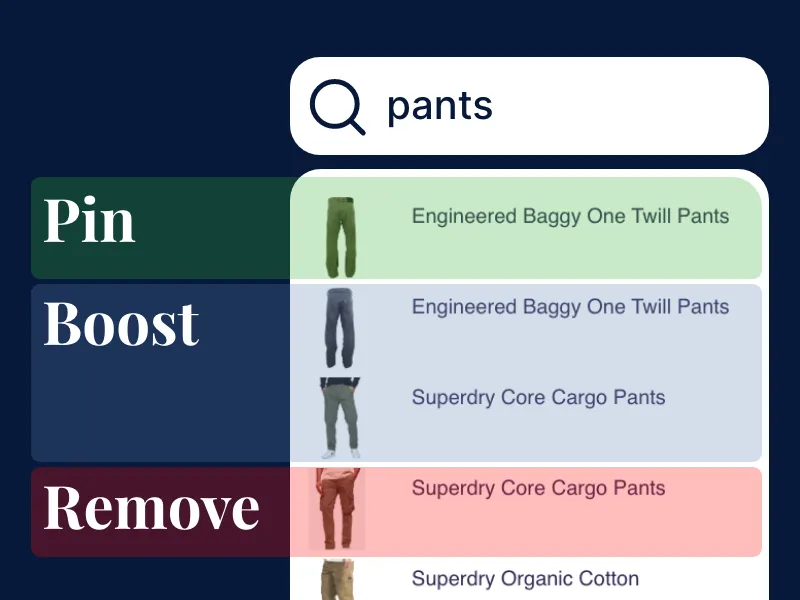
 Word Boosts: Precise Ecommerce Search Optimization
Control how products appear in search results for specific keywords. You can now pin, exclude, or boost products based on attributes like brand or category.
