
Personalization vs customization
A customer lands on your store and sees product recommendations tailored to their browsing history. That’s personalization.
A customer opens a product page and selects their preferred color, size, and monogram engraving. That’s customization.
The two terms get used interchangeably in ecommerce, but they represent fundamentally different approaches to creating relevant shopping experiences. Understanding the distinction helps you invest in the right capabilities for your store.
Personalization: The system adapts to the customer
Personalization happens automatically. The customer doesn’t need to do anything; the system observes their behavior and adjusts the experience accordingly.
Examples of ecommerce personalization:
- Search results that prioritize products matching a customer’s size, style, and price preferences based on previous behavior
- Product recommendations that reflect individual purchase history and behavioral patterns
- Homepage content that adapts to returning visitors based on their interests
- Email content that features products relevant to each recipient’s browsing and purchase history
- Sort order on category pages that shifts based on what similar customers tend to buy
The defining characteristic: the customer doesn’t choose to be personalized. It happens in the background, informed by data.
The value proposition is friction reduction. Personalization removes the work of finding relevant products from the customer and puts it on the system. In a store with thousands of products, that’s meaningful, especially on mobile where scrolling through irrelevant options is exhausting.
Customization: The customer adapts the experience
Customization requires active participation from the customer. They make explicit choices that shape their experience.
Examples of ecommerce customization:
- Product configurators where customers choose colors, materials, and features
- Preference centers where customers select their interests, sizes, and communication preferences
- Filters and sorting that customers manually apply to browse results
- Saved lists and wishlists that customers curate themselves
- Account settings where customers define their shipping preferences, payment methods, and notification rules
The defining characteristic: the customer is in control. They explicitly tell the system what they want.
The value proposition is agency. Customers feel ownership over their experience. For complex products (custom furniture, bespoke jewelry, configured electronics) customization isn’t optional. It’s the product itself.
When to use each approach
Personalization works best when:
- The customer doesn’t know what they want. Someone browsing for a gift, exploring a new category, or shopping casually benefits from a system that surfaces relevant products automatically.
- The product catalog is large. Stores with thousands of SKUs need personalization to prevent customers from drowning in choices. Search personalization and recommendation engines exist because no customer will manually browse 10,000 products.
- Speed matters. For repeat purchases, subscriptions, and routine shopping, personalization removes friction. The system remembers preferences so the customer doesn’t have to re-specify them each visit.
- The customer is new. First-time visitors can’t customize an experience they haven’t seen yet. Personalization using collective intelligence can provide a relevant experience from the first pageview.
Customization works best when:
- The customer knows exactly what they want. An athlete searching for running shoes with specific pronation support and width requirements needs filters, not algorithmic suggestions.
- The product requires specification. Custom-printed t-shirts, configured laptops, and bespoke furniture all require the customer to define what they’re buying.
- Trust needs to be built. Preference centers and explicit opt-ins give customers control over their experience, which builds trust, especially around email frequency and communication preferences.
- Legal compliance requires it. GDPR and similar regulations often require explicit consent for data-driven personalization. Customization (explicit preferences) is inherently consent-based.
The hybrid approach
The most effective ecommerce experiences combine both.
A customer sets their shoe size in their profile (customization). The system uses that preference to filter search results and recommendations (personalization). The customer saves products to a wishlist (customization). The system sends a price drop alert when a wishlisted product goes on sale (personalization).
This layered approach works because customization provides explicit, high-confidence signals (the customer told you their size, so you know for certain) while personalization fills in the gaps with behavioral inference.
For SMB ecommerce stores, the practical recommendation is:
- Start with personalization. It works automatically and requires no customer effort. Implement search personalization and product recommendations as the foundation.
- Add strategic customization. Preference centers for email, size and style preferences in accounts, and filters on category pages. These capture explicit signals that make personalization even better.
- Connect them. Make sure customization choices feed into the personalization engine. A customer who sets size preferences should see those reflected everywhere, not just in the filter panel.
What hyper-personalization looks like in practice
Standard personalization adapts to a customer’s known preferences: purchase history, browsing behavior, stated size preferences. Hyper-personalization goes further. It uses real-time behavioral signals, predictive algorithms, and individual context (device, time of day, session path, recency) to adapt every element of the experience at the individual level, not just the segment level.
The distinction matters because hyper-personalization requires an AI layer that can process multiple data signals simultaneously. Rather than “customers who bought X also bought Y,” the system reasons about this specific customer, in this session, given their last three interactions, and surfaces the product they are most likely to buy at the moment they are most likely to buy it. AI-powered personalization platforms automate this level of inference at scale, making it accessible without a custom machine-learning team.
For ecommerce teams evaluating platforms, the useful question is no longer “does it personalize?” because virtually every modern platform does. The sharper question is whether it adapts in real time, at the individual level, based on behavioral signals beyond static purchase history. For a quick-reference version of the distinction with an FAQ, see our personalization vs customization guide.
The business case: Retention and lifetime value
The ROI case for personalization is strongest in customer retention and lifetime value, not only first-purchase conversion.
Personalization’s retention impact:
- Returning customers who receive personally relevant recommendations show higher repeat purchase rates, because the path to the right product is shorter
- Personalized triggered emails (abandoned cart, post-purchase, browse abandonment) consistently outperform batch campaigns on open rates and revenue per send, because they are timed to demonstrated intent rather than a schedule
- Personalized search results reduce time-to-purchase, which translates directly into session efficiency and lower drop-off
Customization’s loyalty impact:
- Customers who configure or customize products are more invested in the outcome, and return rates are typically lower because the customer defined exactly what they wanted
- Explicit preferences captured through preference centers (size, style, communication frequency) improve the accuracy of downstream personalization, creating a compounding feedback loop
- Trust built through transparency, where the store reflects back the preferences a customer stated themselves, is more durable than inferred preferences alone
The most important caveat: personalization that infers incorrectly can damage the relationship faster than no personalization at all. An obviously wrong recommendation (promoting baby products to a customer who bought a gift, or continuously surfacing out-of-stock items) erodes trust quickly. This is why explicit customization signals (stated sizes, wishlist behavior, saved preferences) should take priority over algorithmic inference when both are available. The hybrid approach works best when the system knows which signal to trust.
Vertical example: Fashion and apparel
Fashion is the vertical where the personalization-customization distinction is sharpest, and where the two approaches create the most value together.
Personalization in fashion: A returning customer who has bought medium-sized tops sees search results filtered to their size automatically. The homepage surfaces styles consistent with their previous purchases without any manual action. A browse-abandonment email features the exact product they viewed instead of a generic “new arrivals” prompt. None of this required the customer to do anything, because the system observed and adapted on its own.
Customization in fashion: A customer commissioning an embroidered gift selects size, colorway, and monogram text. A shoe configurator lets them choose sole type, upper material, and color combination. These choices create a product that exists only because of that customer’s explicit decisions. The experience is high-effort by design, and that effort is part of the perceived value.
The hybrid in action: A customer who has configured several custom orders (consistently choosing navy, clean lines, premium materials) builds an implicit style profile through their customization history. A well-integrated platform captures those signals and uses them to rank standard catalog products, surfacing navy minimalist items at the top of their browse results without any rule-writing. The customer’s explicit choices made the automatic personalization smarter.
The investment question
Personalization requires technology investment: data infrastructure, recommendation algorithms, and integration across touchpoints. It scales well: once the system is set up, it improves as more data flows through it.
Customization requires UX investment: designing intuitive configuration tools, preference interfaces, and filter systems. It scales with product complexity: the more configurable your products, the more investment is needed.
For most ecommerce stores, personalization offers better ROI because it works for all visitors automatically. Customization is additive: it enhances the experience for engaged customers who take the time to configure their preferences.
How this connects to Hello Retail
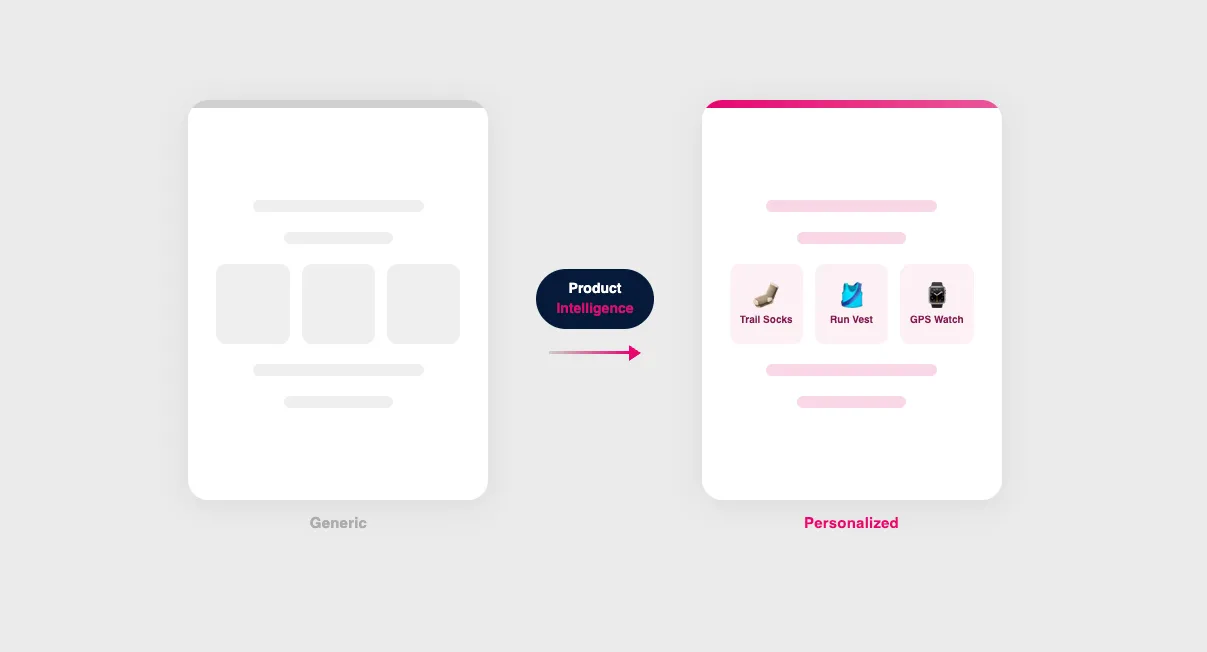
Hello Retail focuses primarily on the personalization side of this equation. The search, recommendations, and triggered email products adapt the shopping experience automatically based on behavioral data and Product Intelligence.
The system also captures explicit customization signals when available (size preferences, wishlisted products, saved searches) and feeds them into the personalization engine. This means a customer’s explicit choices make the automatic personalization more accurate over time.
For stores that want to measure the ROI of their personalization efforts, the analytics layer provides visibility into how both explicit preferences and behavioral signals contribute to revenue.
Key takeaways
- Personalization is automatic (the system adapts to the customer using behavioral signals); customization is explicit (the customer actively shapes their own experience)
- Hyper-personalization extends standard personalization with real-time, individual-level AI inference; evaluating platforms on this capability is worthwhile for high-volume stores
- Personalization drives the strongest ROI in retention and repeat purchase rate; customization drives loyalty through product ownership and lower return rates
- Personalization that infers incorrectly can damage trust, so explicit customization signals should override algorithmic inference when available
- The most effective ecommerce experiences combine both: start with personalization for scale, add customization signals to make it more accurate, and connect them so each informs the other
- Fashion illustrates the principle clearly: automatic size-filtering and style recommendations (personalization) work alongside product configurators and monogramming (customization) in the same store
Keep reading
 Industry Tips
Improve Klaviyo emails with data
Your Klaviyo flows are solid. But if every abandoned cart email shows the same generic recommendations, you're leaving revenue on the table.
 Industry Tips
How to measure ecommerce personalization ROI (with real numbers)
McKinsey: top personalizers earn 40% more revenue from it. 26% of marketers see $3-5 back per $1 spent. The A/B-test framework, the three metrics that matter, and what holdout groups actually reveal.
 Industry Tips
GEO for ecommerce: How to get your products cited by AI search engines
68% of US Google searches now end without a click, and AI search converts better than any other channel for retailers. Here's how ecommerce stores use Generative Engine Optimization to get cited when ChatGPT, Perplexity, and Google AI recommend products.
