Retail media revenue models compared: CPC, CPM, and hybrid
You’ve decided to launch a retail media program. Brands are interested. The technology is in place. Now comes the question that shapes everything: how do you charge?
The pricing model you choose determines your revenue ceiling, your advertiser relationships, and how much operational complexity you’re signing up for. Get it right and you have a predictable revenue stream that scales with your traffic. Get it wrong and you’ll spend more time managing billing disputes than growing the program.
Three models dominate the retail media landscape. Here’s how each works, who it benefits, and when to use it.
CPC: Cost per click
How it works: Advertisers pay each time a shopper clicks on their sponsored product or banner. No click, no charge.
Typical range: $0.15–$1.50 per click, depending on category competitiveness and product price point. Higher-margin categories (electronics, beauty) command higher CPCs.
Why advertisers like it: Risk is low. They only pay for demonstrated interest. A brand running a $500 monthly CPC campaign knows that every dollar went toward someone who actively engaged with their product.
Why retailers like it: Easy to explain, easy to sell. “You only pay when someone clicks” is the most compelling pitch in advertising. It removes the objection of paying for impressions that nobody sees.
The catch: Revenue is directly tied to click volume, which is tied to traffic. During slow months, revenue drops proportionally. During high-traffic months (Black Friday, seasonal peaks), you’re generating more value for advertisers but your revenue only increases if clicks do too.
Best for: New retail media programs that need to build advertiser trust. CPC is the easiest model to sell because the risk for the brand is minimal. Start here and upgrade to hybrid once you’ve demonstrated performance.
CPM: Cost per thousand impressions
How it works: Advertisers pay a fixed rate per 1,000 impressions of their sponsored placement, regardless of whether anyone clicks.
Typical range: $5–$25 CPM, depending on placement visibility and audience targeting. Homepage banners command premium CPMs. Deep category page placements are cheaper.
Why advertisers like it: Predictable reach. A brand running a product launch wants guaranteed visibility. CPM delivers that. They know exactly how many eyeballs their campaign will reach.
Why retailers like it: Revenue is more predictable than CPC and decoupled from click behavior. Even if a campaign has a low click-through rate, the retailer still earns the full CPM.
The catch: If your placements consistently underperform on clicks and conversions, advertisers will question the value. CPM works when advertisers are buying awareness (product launches, seasonal pushes). It works less well for performance-focused campaigns where brands want to see direct sales attribution.
Best for: Display placements (homepage banners, interstitial ads, checkout page promotions) where the goal is brand awareness rather than direct product clicks. Also works well for retailers with large, premium audiences where the impression itself carries value.
Hybrid: CPC + CPM combined
How it works: The pricing combines a lower base CPM (for guaranteed impressions) with a CPC component (for engaged clicks). Some implementations use a low CPM floor with CPC on top. Others use tiered pricing where the first N impressions are CPM and additional performance is CPC.
Typical structure: $3–$8 base CPM + $0.20–$0.80 per click. The exact split depends on placement type and campaign goals.
Why advertisers like it: They get guaranteed reach (the CPM component) plus performance alignment (the CPC component). It balances brand awareness and direct response in a single campaign.
Why retailers like it: Revenue has a predictable floor (from CPM) with upside (from clicks). This smooths out the revenue volatility of pure CPC while avoiding the “paying for nothing” objection that pure CPM can generate.
The catch: More complex to implement, explain, and reconcile. Billing requires tracking both impressions and clicks, and advertisers may push back on paying CPM for impressions that don’t lead to clicks.
Best for: Established retail media programs with proven performance data. Once you can show advertisers that your placements generate strong CTR and conversions, hybrid pricing lets you capture more value from high-performing campaigns.
Choosing your model: A decision framework
Start with CPC if:
- You’re launching a new retail media program
- Your advertiser relationships are new and trust needs to be built
- Your primary placement is sponsored products in search results and recommendations (performance-oriented surfaces)
- You have fewer than 20 brand partners
Start with CPM if:
- You have premium display inventory (homepage, high-traffic category pages)
- Your brands are primarily interested in awareness campaigns
- You have strong traffic with a clearly defined audience demographic
- You want predictable revenue regardless of click behavior
Move to hybrid when:
- You have 6+ months of CPC or CPM performance data to show advertisers
- You’ve demonstrated consistent CTR and conversion rates
- You’re scaling beyond 20 brand partners
- You want to maximize revenue from high-performing placements while maintaining a revenue floor
Pricing your placements
Whatever model you choose, price discovery is iterative. Don’t agonize over the perfect CPC or CPM on day one. Set a reasonable starting point and adjust based on demand.
Starting point guidance:
- If you’re in a niche with high product prices (furniture, electronics), start higher
- If you’re in a competitive vertical with many brands vying for placements, start lower and let competition push prices up
- If your audience is highly targeted (specialty retailer vs. general marketplace), charge a premium for the audience quality
The auction approach: For sponsored product placements, consider an auction model where brands bid on positions. This naturally discovers the right price and creates competition that increases your revenue over time. Hello Retail’s Retail Media takes a different route: a vendor-funded model where brands fund the sponsored products and banners that surface where they’re most relevant to the shopper.
Measuring program health
Regardless of your pricing model, track these metrics to assess program health:
-
Fill rate. What percentage of your available ad inventory is sold? Below 30% means you need more advertisers. Above 80% means you should raise prices.
-
Advertiser retention. Are brands renewing campaigns? If not, investigate performance issues.
-
Revenue per 1,000 sessions (RPM). Your overall retail media revenue divided by traffic in thousands. This normalizes for traffic fluctuations and gives you a consistent measure of monetization efficiency.
-
Customer experience impact. Monitor your site’s conversion rate and bounce rate before and after introducing retail media placements. If core metrics degrade, your placements are too aggressive.
For mid-market retailers launching their first programs, starting with CPC and tracking these four metrics provides the data foundation you need to evolve your pricing model intelligently.
How this connects to Hello Retail
Hello Retail’s Retail Media platform supports CPC, CPM, and hybrid pricing models, giving retailers flexibility to evolve their program as it matures. The platform handles bid management, impression tracking, click attribution, and advertiser reporting.
For retailers already using Hello Retail for search and recommendations, the Retail Media layer integrates directly into existing surfaces. Sponsored products appear naturally within search results and recommendation carousels without requiring separate ad technology.
The platform also provides the performance data (CTR, conversion attribution, ROAS) that advertisers need to justify ongoing investment, which is essential for building the long-term brand relationships that sustain a retail media program.
Key takeaways
- CPC is the easiest model to launch with. Low risk for advertisers, easy to explain, builds trust for new programs
- CPM works best for premium display placements and awareness campaigns where guaranteed reach is the value proposition
- Hybrid pricing captures the most value but requires proven performance data and established advertiser relationships
- Start with CPC, track fill rate and advertiser retention, and evolve to hybrid as your program matures
Keep reading
 Retail Media
Sponsored products best practices for ecommerce retailers
Sponsored products can drive revenue without annoying customers. Here are the best practices for implementing them on your ecommerce platform.
 Retail Media
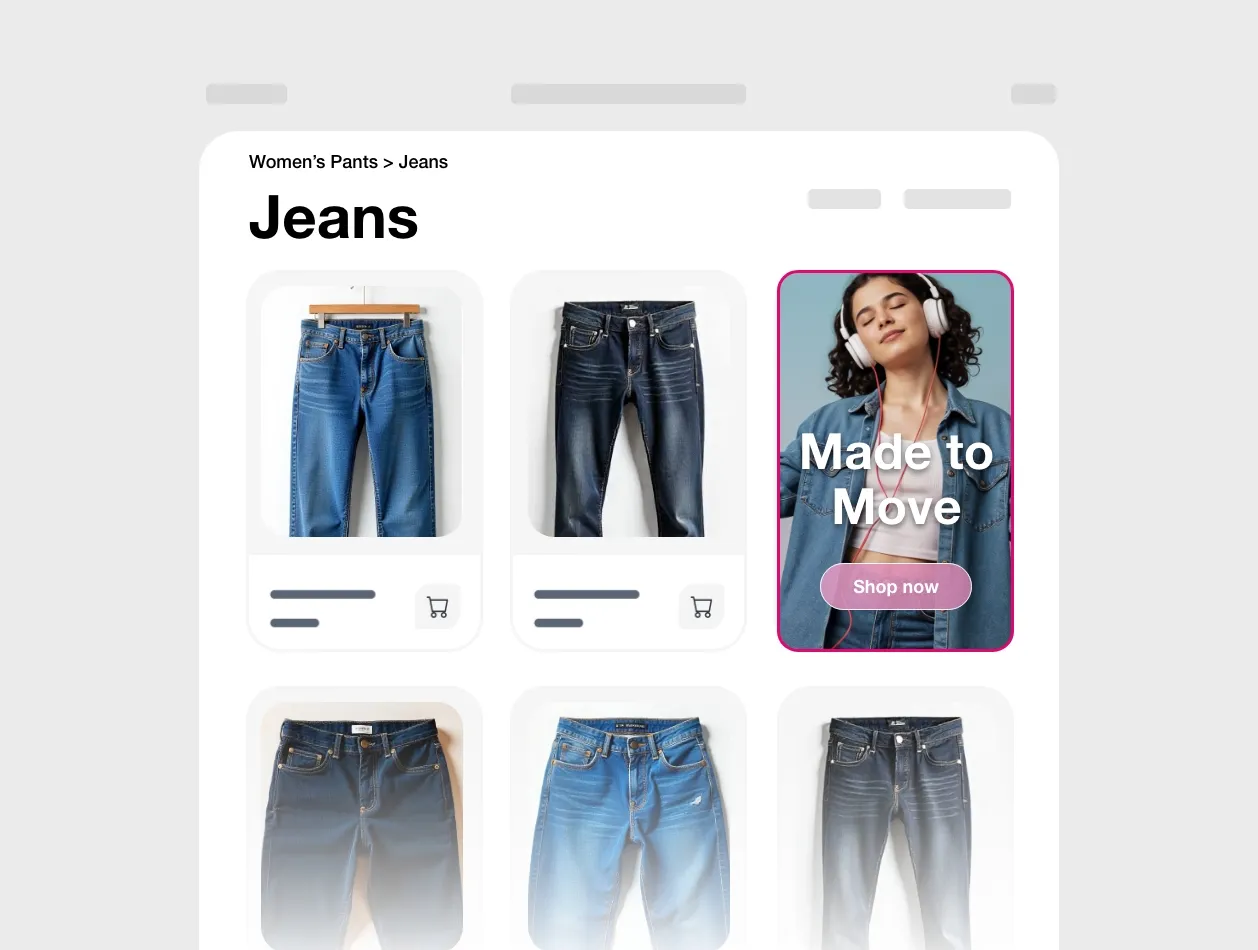
Introducing Retail Media Banners
Create, target, and manage on-site retail media banners powered by Product Intelligence AI, no manual guesswork needed.
