Sponsored products best practices for ecommerce retailers

Sponsored products are the backbone of retail media. They generate more revenue than display banners, deliver better ROI for advertisers, and (when done right) actually improve the customer experience.
When done wrong, they erode trust, clutter search results with irrelevant products, and make your site feel like it was designed by the advertising team rather than the product team.
The difference between those two outcomes is execution. Here’s how to get it right.
Relevance is non-negotiable
The single most important principle: a sponsored product must be relevant to the context where it appears.
If a customer searches for “wireless headphones” and a sponsored listing for a bluetooth speaker appears in the results, that’s acceptable: the products are related. If a sponsored listing for a kitchen blender appears, that’s a failure. The customer’s trust in your search results just dropped, and no amount of ad revenue compensates for that.
Relevance rules should be built into the system, not left to advertiser discretion. When brands set up campaigns, they should target keywords and categories. But the retail media platform should enforce relevance at the point of delivery, filtering out placements that don’t match the customer’s current context.
This is where the integration between retail media and search/recommendation technology matters. If your sponsored products run through the same relevance algorithm as organic results (just with a bid-based boost), relevance is maintained automatically.
Labeling: A strategic choice you make deliberately
Whether to label sponsored products, and how prominently, is a business decision. Some retailers mark every paid placement clearly. Others integrate sponsored products into the organic feed without a visible distinction. Both approaches are in production at scale, and either can work depending on the audience, the category, and the retailer’s stance on advertiser transparency.
What matters within a single retailer is consistency: the customer should never feel the rules just changed mid-session.
Reasons to lean toward visible labeling:
- Categories where trust drives conversion (health, finance, considered B2B purchases)
- Audiences who research products deeply before buying
- Jurisdictions with active enforcement of advertising-disclosure rules
- Programs where the advertiser brand wants the placement to be recognized as paid
Reasons to lean toward integrated, unlabeled placement:
- Recommendation surfaces where “what we picked for you” and “what was promoted to you” are deliberately blurred
- Categories where customers don’t expect editorial neutrality from the retailer
- Retailers who treat sponsored slots as merchandising decisions rather than ad inventory
If you do label, do it well:
- Pick one term (“Sponsored,” “Ad,” or “Promoted”) and use it everywhere
- Place the badge in the same location on every sponsored card
- Don’t hide it with low contrast or tiny text
- Don’t use euphemisms like “Featured” or “Recommended for you” if the badge is meant to communicate that the placement is paid. Those words blur the line
Labeling clearly does not necessarily reduce click-through. Customers who click on a clearly marked sponsored product have made an informed choice, which often correlates with stronger downstream conversion.
Limit the ratio
How many sponsored products should appear in a set of search results or recommendations?
There’s no universal rule, but a good starting point: no more than 20% of visible results should be sponsored. On a page showing 20 products, that’s 4 sponsored listings. In a recommendation carousel showing 6 products, that’s 1 sponsored product.
Going above 20% risks two problems:
- The customer experience degrades as organic relevance is diluted
- The effectiveness of each sponsored placement decreases due to competition for attention
Some retailers cap at one sponsored product per search query. Others allow up to three in a 20-result page. Test different ratios and measure the impact on both ad revenue and organic conversion rate. If your site’s overall conversion rate drops as you increase sponsored product density, you’ve gone too far.
Position strategically
Not all positions are equal. The first product in search results gets dramatically more attention than the fifth. A sponsored product in position 1 commands a premium price, and generates premium clicks.
Best practices for positioning:
- Position 1-2 in search results: Reserve for the highest-bidding, most relevant sponsored products. These are your premium inventory.
- Mid-page injection: Insert a sponsored product after 4-5 organic results. This placement catches scrolling customers without dominating the initial view.
- Recommendation carousels: Limit to one sponsored product per carousel, positioned 2nd or 3rd (not first). Putting a sponsored product first in a “Recommended for you” carousel feels manipulative.
- Category pages: Sponsored products at the top of category listings work well because customers expect curated ordering on category pages.
Give advertisers useful data
Brands invest in sponsored products because they want sales. Give them the data to justify continued investment.
Essential reporting for advertisers:
- Impressions: how many times their sponsored product was shown
- Clicks: how many shoppers clicked through to the product page
- Click-through rate: clicks divided by impressions
- Conversions: purchases attributed to the sponsored click (use a 24-48 hour attribution window)
- ROAS: return on ad spend (conversion revenue divided by ad spend)
The more transparent your reporting, the more confident advertisers feel about their investment. And confident advertisers increase their budgets.
Maintain organic integrity
Here’s the tension at the heart of sponsored products: every sponsored placement takes a position that would otherwise go to an organically ranked product. The customer experience depends on your organic ranking being trustworthy.
Rules to protect organic integrity:
-
Never let sponsored products replace top organic results entirely. If a customer’s search clearly matches a specific organic product (exact match on product name, for example), that product should appear regardless of whether a competitor has a sponsored placement.
-
Don’t let the same brand dominate. If a brand has both the top organic result and a sponsored placement, cap their combined visibility to prevent the results from feeling like a single-brand storefront.
-
Monitor search quality metrics. Track search-to-purchase conversion rate before and after introducing sponsored products. If it drops, your sponsored placements are degrading relevance.
Testing and optimization
Treat your sponsored products program like a product, not a set-it-and-forget-it feature.
Test placement density. Run A/B tests with different sponsored-to-organic ratios. Measure both ad revenue and organic conversion rate. Find the ratio that maximizes total revenue (ad revenue + product sales), not just ad revenue.
Test visual presentation. Does a subtle “Sponsored” badge outperform a border highlight? Does a gray background on sponsored cards help or hurt CTR? Small design changes can significantly impact both customer trust and advertiser performance.
Test bidding strategies. If you’re using auction-based pricing, experiment with minimum bid floors and bid caps. Too-low minimums let low-quality ads through. Too-high minimums limit advertiser participation.
For mid-market retailers starting their programs, these optimizations are second-stage priorities. Get the relevance and labeling right first. Optimize the details once you have enough data.
How this connects to Hello Retail
Hello Retail’s Retail Media platform implements these best practices by design. Sponsored products flow through the same relevance engine as organic search results and recommendations, ensuring contextual relevance is maintained. The platform enforces configurable density limits and provides advertisers with full-funnel reporting.
Key takeaways
- Relevance must be enforced by the system rather than left to advertiser discretion. Irrelevant sponsored products erode customer trust
- Choose your labeling approach deliberately. Visible labels and integrated placements both work; what matters is consistency within a single retailer
- Limit sponsored products to no more than 20% of visible results and protect organic ranking integrity
- Provide advertisers with conversion attribution and ROAS data. Confident advertisers increase their budgets
Keep reading
 Retail Media
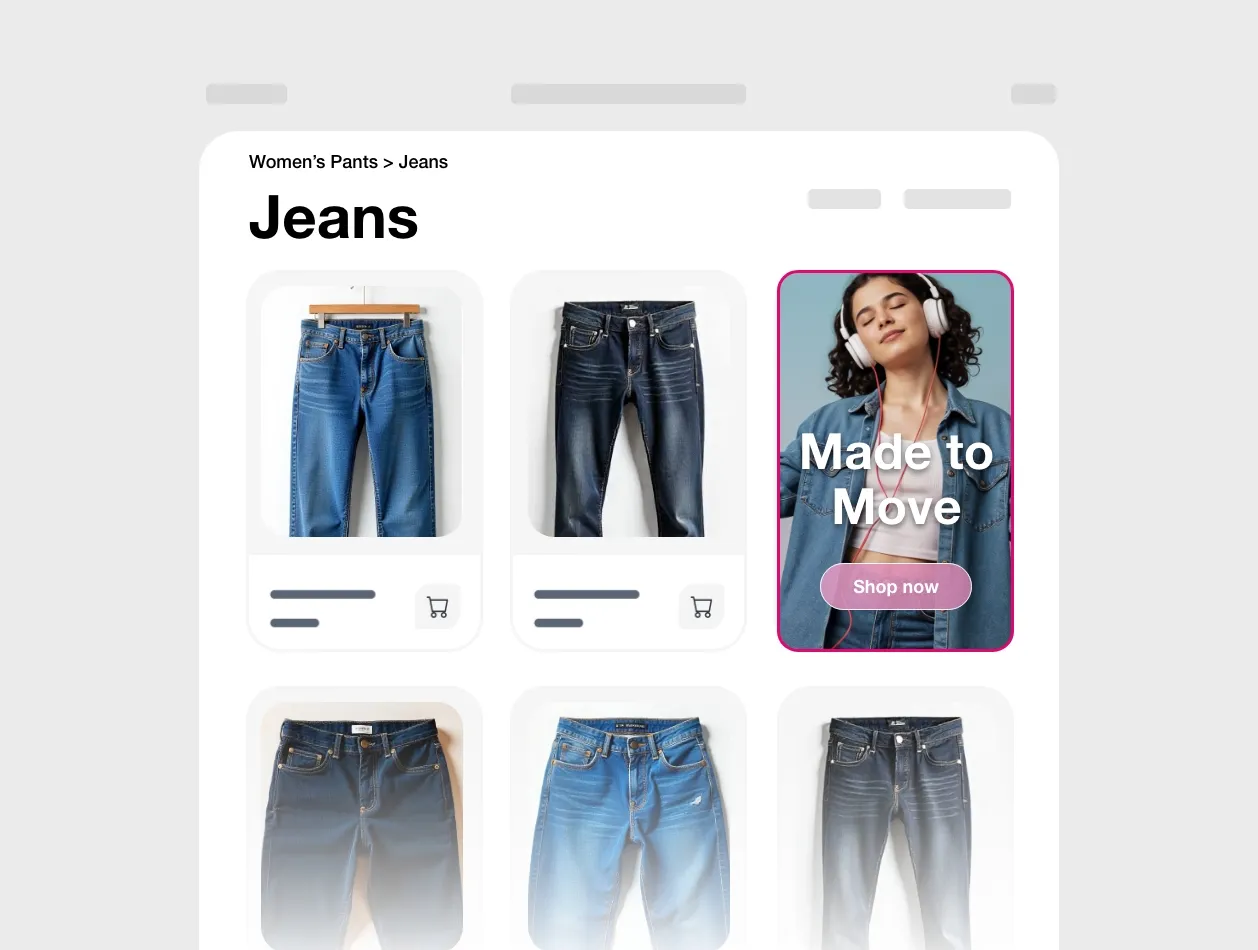
Introducing Retail Media Banners
Create, target, and manage on-site retail media banners powered by Product Intelligence AI, no manual guesswork needed.
 Industry Tips
Retail media for mid-market retailers
Retail media isn't just for Amazon and Walmart. Mid-market retailers can launch their own retail media programs with the right approach.