
Enterprise personalization platforms: Real costs and what mid-market ecommerce actually needs
The pitch is always the same. “You need enterprise-grade personalization.” The sales deck shows a slide with six product modules, a data platform, an engagement layer, and a content management system. It looks comprehensive. It looks like the future.
Then you ask about pricing, implementation timeline, and team requirements. The answer involves six figures, six months, and a dedicated project team. For an ecommerce store that wanted better search and product recommendations.
This is the enterprise tax. It is the most common misstep mid-market ecommerce teams make when choosing a personalization platform.
What “enterprise” actually means
Enterprise personalization platforms are built for large organizations with dedicated platform teams, complex content requirements, and the budget to match. There is nothing wrong with that. Enterprise companies need enterprise tools.
“Enterprise” is a label for complexity as much as a label for capability. Here is what it typically comes with:
Separate products that require separate implementations
Many enterprise personalization suites are not one product. They are three, four, or six products, often acquired separately and branded under one umbrella. Discovery for search and merchandising. Engagement for marketing automation. Content for CMS. Data hub for customer intelligence.
Each module has its own setup process, its own data model, its own API, and its own learning curve. Even if you only need search and recommendations, you are buying into an architecture designed for the full suite.
The integration between these modules is not automatic. Making “one platform” actually behave like one platform requires implementation effort: connecting data flows, resolving entity models, and configuring cross-module behaviors. That is implementation work your team has to plan, execute, and maintain.
Implementation timelines measured in months
Enterprise platforms assume enterprise timelines. Discovery workshops. Data modeling sprints. Staging environments. User acceptance testing. Phased rollouts. A dedicated project manager from the vendor’s side, and a dedicated project team on yours.
For a company with 50 ecommerce developers, this is normal. For a team of three to five people running an online store, this is a second job for half a year.
The implementation timeline is more than an inconvenience. It is a direct cost: every month without personalization is a month of generic product listings, unsorted search results, and missed conversion opportunities.
Features you pay for but never configure
Enterprise suites are packed with capabilities. Multi-channel marketing automation across 13 or more channels. Advanced audience segmentation with dozens of condition types. AI content generation. SMS campaigns. Push notifications. Web overlays.
These features exist because enterprise customers with large marketing teams use them. But if your personalization needs are search, recommendations, and email (the three capabilities that drive the most direct ecommerce revenue), you are paying for a jet when you need a car.
The features you do not use are not free. They add complexity to the dashboard, noise to the documentation, and overhead to the implementation. Your team spends time navigating capabilities they will never configure.
The mid-market reality
Mid-market ecommerce teams have a specific profile. Understanding it is the key to choosing the right platform.
Team size: 2 to 10 people. Not 50. The ecommerce manager, a developer or two, a merchandiser, maybe a marketer. These people wear multiple hats. They do not have bandwidth for a six-month implementation project.
Budget: proportional to revenue. Mid-market stores are profitable but not flush with enterprise-scale budgets. Every tool needs to justify its cost with measurable impact, beyond theoretical future value.
Needs: focused. Search that converts. Recommendations that increase basket size. Email personalization that brings people back. These three capabilities account for the majority of personalization-driven revenue in ecommerce. Everything else is a nice-to-have.
Timeline: weeks, not months. Seasons change. Campaigns launch. Competitors move. A personalization platform that takes six months to implement misses two selling seasons.
The complexity trap
The danger is not choosing the wrong platform on purpose. It is being sold enterprise because the vendor’s sales motion is built for enterprise.
The evaluation process starts rationally. You need better search and recommendations. You create a shortlist. The enterprise vendor makes the shortlist because their brand is recognizable and their feature list is comprehensive.
Then the enterprise sales process takes over. A three-month evaluation. Technical workshops. Proof of concept. Reference calls. Security reviews. By the time you sign, the evaluation itself has taken longer than the entire implementation should.
Once you are in, switching costs make leaving expensive. The implementation was complex, so undoing it is complex too. Your data is in their format. Your team learned their tools. The sunk cost fallacy keeps you paying enterprise prices for mid-market needs.
What “enterprise-grade” should actually mean
Here is the reframe: enterprise-grade should describe the quality of the technology, not the complexity of the experience.
AI that works from day one, without months of behavioral data collection and manual rule configuration. Product Intelligence that understands your catalog from its attributes, so recommendations are relevant from the first visitor.
A merchandiser dashboard that your team actually uses, where business rules, boost and bury logic, synonyms, and campaign configurations are accessible without developer involvement.
A single platform where search, recommendations, email, retail media, and audience segmentation share one intelligence layer. Not six modules with six data models.
Pre-built integrations for the ecommerce platforms mid-market stores actually run on: Shopify, Magento, WooCommerce, Shopware, BigCommerce, Prestashop, Norce.
This is enterprise-grade capability delivered with mid-market simplicity. The quality without the overhead. The intelligence without the complexity tax.
The a la carte alternative
The enterprise model bundles everything and charges accordingly. The alternative is a la carte: start with what you need and expand as you grow.
Need search and recommendations? Start there. Pricing starts at EUR 540/month, with no custom enterprise quote that requires a sales call to learn.
Ready for email personalization? Add it. Want to monetize your product placements with retail media? Add it. Each module shares the same Product Intelligence engine, so adding a new capability does not require a new implementation. It is a configuration change.
This model keeps costs proportional to value. You are not paying for a marketing automation suite when all you needed was personalized product recommendations.
The questions to ask
If you are evaluating personalization platforms and an enterprise suite is on your shortlist, ask these questions:
“What is the minimum implementation for search and recommendations only?” If the answer involves a multi-month project plan, the platform is not built for your team size.
“Can my merchandiser make changes without a developer?” Ask for a live demo where a non-technical user configures a boost rule, adds a synonym, and creates a merchandising campaign. If it requires training, ask how many hours.
“What do we pay for modules we do not use?” Enterprise pricing often includes the full suite whether you use it or not. Understand what you are paying for versus what you will actually configure.
“What is your median implementation time for a store our size?” Median, not best-case. For a mid-market ecommerce store, the answer should be weeks. If it is months, the platform is not designed for you.
“Can we start with one module and add more later?” If the answer is yes but the pricing does not change, you are paying for an enterprise bundle with an a la carte label.
The bottom line
Enterprise personalization platforms exist because enterprise companies need them. The problem is when mid-market ecommerce teams are sold enterprise because the vendor’s sales motion, pricing, and implementation process do not scale down.
If you have a 50-person ecommerce team, a dedicated platform engineering group, and a seven-figure technology budget, enterprise suites make sense. They offer depth and breadth that focused platforms do not.
If you have a small team, a proportional budget, and the need to move fast, the enterprise tax is real, and it compounds. You pay more, wait longer, use less, and switch harder.
The right platform for mid-market ecommerce is one that delivers enterprise-grade intelligence without enterprise-grade complexity. One that respects your team size, your budget, and your timeline.
Curious how a focused platform compares to an enterprise suite? See our side-by-side comparison of Hello Retail vs enterprise personalization.
Keep reading
 Industry Tips
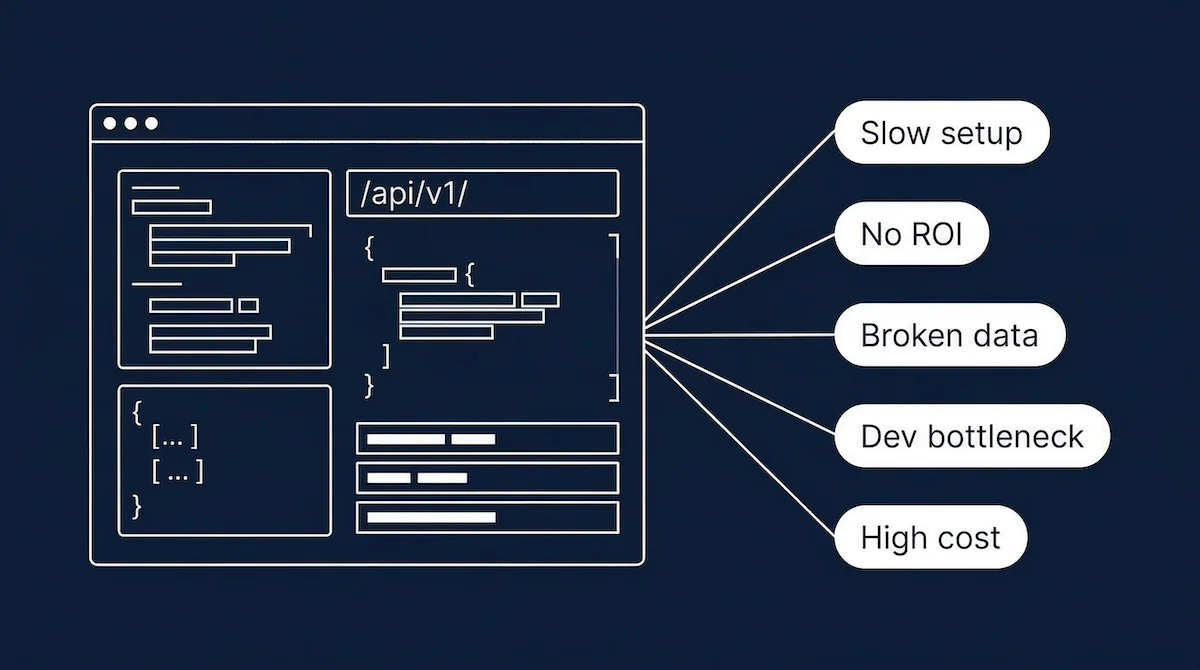
5 signs your personalization platform is holding you back
Struggling with slow implementation, developer bottlenecks, or unclear ROI? Here are five signs it might be time to switch personalization platforms.
 Industry Tips
When developer-first search becomes a bottleneck
API-first search gave your developers full control. But now your merchandisers file tickets for every boost rule, and your recommendation logic lives in custom code. Here's when search infrastructure stops being an advantage.
