
Why ecommerce personalization shouldn't take months to implement
Why ecommerce personalization shouldn’t take months to implement
You already know personalization works. The business case is clear. Leadership is on board. You have picked a platform — or you are about to.
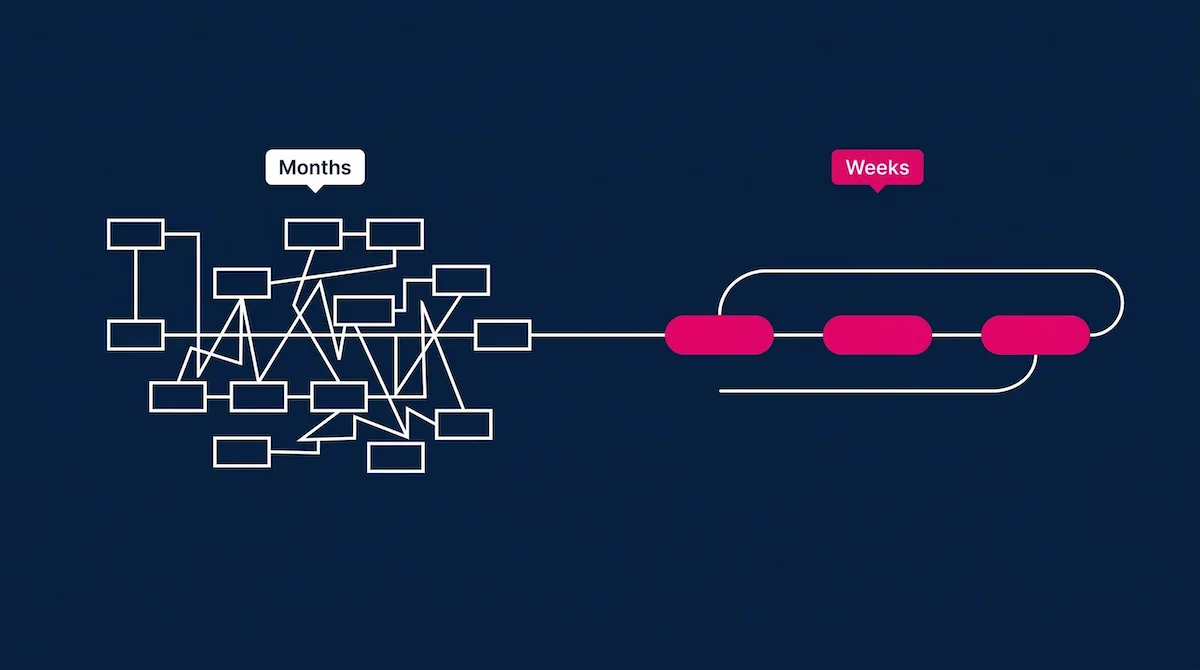
And then someone tells you the implementation will take three to six months.
Multi-phase rollouts. Dedicated developer sprints. Exhaustive go-live checklists. Formal readiness reviews before you can even turn it on in production. By the time personalization is actually running on your site, two quarters have passed and your competitors have already moved on.
This is a problem the ecommerce industry has quietly accepted for too long. But it does not have to be this way.
The hidden cost of slow implementations
When a personalization platform takes months to implement, the cost goes far beyond the implementation budget. There are several compounding effects that rarely show up in the vendor’s ROI calculator.
Lost revenue during the gap
Every week your personalization is not live is a week of generic product recommendations, unpersonalized search results, and one-size-fits-all emails. That is real revenue left on the table — not theoretical future gains, but money you are actively not making.
Developer opportunity cost
If your implementation requires a dedicated development team for months, those developers are not working on other priorities. They are not improving your checkout flow, building new features, or fixing bugs. A complex personalization setup does not just cost developer hours — it consumes roadmap capacity.
Stakeholder fatigue
The longer the gap between “we bought a personalization platform” and “customers are seeing personalized experiences,” the harder it becomes to maintain internal momentum. Budget owners start asking questions. Other departments lose patience. By the time the platform goes live, the organizational energy behind it has dissipated.
Configuration fragility
Complex implementations often come with complex configurations. Case-sensitive fields. Rigid data schemas. Multi-step validation processes. Every layer of complexity is a layer where things can break — and when they break, it takes specialized knowledge to fix them. You end up dependent on a small number of people who understand the system, which is a risk in itself.
Why implementations get complicated in the first place
Not every platform is built the same way, and the differences in architecture directly affect how long it takes to go from contract to live.
Some platforms were built as developer tools first. They expose powerful APIs and flexible data models, but they assume you have engineers who will wire everything together. The platform provides the building blocks; your team provides the glue. This approach can be powerful for organizations with large development teams and custom requirements, but it puts the burden of integration squarely on you.
Other platforms take a siloed approach — separate products for search, recommendations, email, and analytics that were either built independently or acquired and stitched together. Each module has its own setup process, its own data requirements, and its own learning curve. Implementing one is manageable. Implementing the full suite means running multiple parallel implementation projects.
Then there are platforms designed around fast time-to-value. These tend to share a few characteristics:
- A unified data layer that all features read from, so you integrate your product catalog once and everything works
- Script-based installation options alongside APIs, so you can get basic functionality running without deep backend work
- Pre-built integrations with the ecommerce platforms teams actually use
- No cold-start problem, meaning the system delivers relevant results from day one rather than requiring weeks of behavioral data collection
The architecture determines the implementation timeline. If you are evaluating platforms, this is one of the most important questions to ask.
What fast personalization setup actually looks like
A fast implementation does not mean a shallow one. It means the platform was designed so that the complex work happens behind the scenes rather than in your sprint backlog.
Here is what a realistic fast setup looks like:
1. Connect your data
Your product catalog is the foundation. A well-designed platform ingests your product feed — whether from Shopify, Magento, WooCommerce, Shopware, Norce, or a custom setup — and immediately starts analyzing it. At Hello Retail, our Product Intelligence engine already learned from over 250 million products. When your catalog connects, the system understands product relationships, categories, and attributes without manual mapping. There is no cold-start period where recommendations are random because the system has not learned enough yet.
2. Install and integrate
A developer adds the Hello Retail script to your store — through a platform plugin for Shopify or WooCommerce, a Composer package for Magento, or a manual setup for custom builds. This connects tracking, cart data, and conversion events. For most standard platforms, this takes days rather than weeks.
3. Configure your experiences
With data flowing, your merchandising team configures the experiences you want from the dashboard. Which Search behaviors matter most? Where should Product Recommendations appear? What emails should go out — should Product Agents send automated product-aware messages through Klaviyo? Merchandising rules, boost and bury logic, audience segments — these are business decisions, and business users control them from the dashboard without writing code.
4. Test, optimize, and go live
With configurations in place, you test, verify the integration, tune the results, and go live. No formal go-live committees. No multi-page readiness checklists. No waiting for a vendor to sign off on your setup.
The questions to ask before you commit
If you are evaluating ecommerce personalization platforms and implementation speed matters to you (it should), here are the questions that will reveal the truth about timelines:
“What does a typical implementation look like, week by week?” Vague answers like “it depends on your requirements” are a warning sign. A platform that is genuinely fast to implement can describe a concrete timeline.
“How much developer time is required?” Some platforms need dedicated backend engineers for the entire implementation. Others need a developer for an afternoon to paste a script tag. The range is enormous, and it directly affects your total cost.
“Can we go live with one feature and add more later?” An a la carte model — where you can start with search, add recommendations next month, and layer in email personalization later — is far less risky than an all-or-nothing implementation. You get value immediately and expand at your own pace.
“What happens with new products?” If the system needs weeks of behavioral data before it can recommend a new product, you have a cold-start problem. That means every product launch, every seasonal collection, and every new arrival goes through a dead period where it is invisible to personalization. A platform that understands products from their catalog attributes — not just behavioral data — avoids this entirely.
Why this matters more than feature checklists
It is tempting to evaluate personalization platforms by comparing feature lists. Who has more recommendation algorithms? Whose AI is more advanced? Which one supports the most email triggers?
Features matter. But a platform with a superior feature set that takes six months to implement will deliver less value in its first year than a slightly less feature-rich platform that goes live in three weeks.
Time-to-value is itself a feature — arguably the most important one.
The ecommerce landscape moves fast. Customer expectations evolve. Competitors adapt. A personalization platform that takes months to implement is a platform that was designed for a slower-moving industry.
Ecommerce is not that industry.
Get personalized results in weeks, not quarters
Hello Retail is a unified ecommerce personalization platform — search, recommendations, email, retail media, audience segmentation, and merchandising — all powered by a single Product Intelligence engine. Most implementations go live within weeks, with both API and script-based integration options.
If you are tired of being told that personalization takes months, book a demo and we will show you what a realistic timeline looks like for your store.