
Data driven personalization for ecommerce: a practical framework
Data driven personalization for ecommerce: a practical framework
“We need to be more data-driven with our personalization.”
You’ve probably heard this in a meeting. Maybe you’ve said it yourself. The problem isn’t the ambition — it’s that “data driven personalization” means everything and nothing at the same time.
Does it mean showing products based on browsing history? Segmenting email lists by purchase behavior? Using AI to predict what customers want? All of the above?
Here’s a practical framework for thinking about it without getting lost in the jargon.
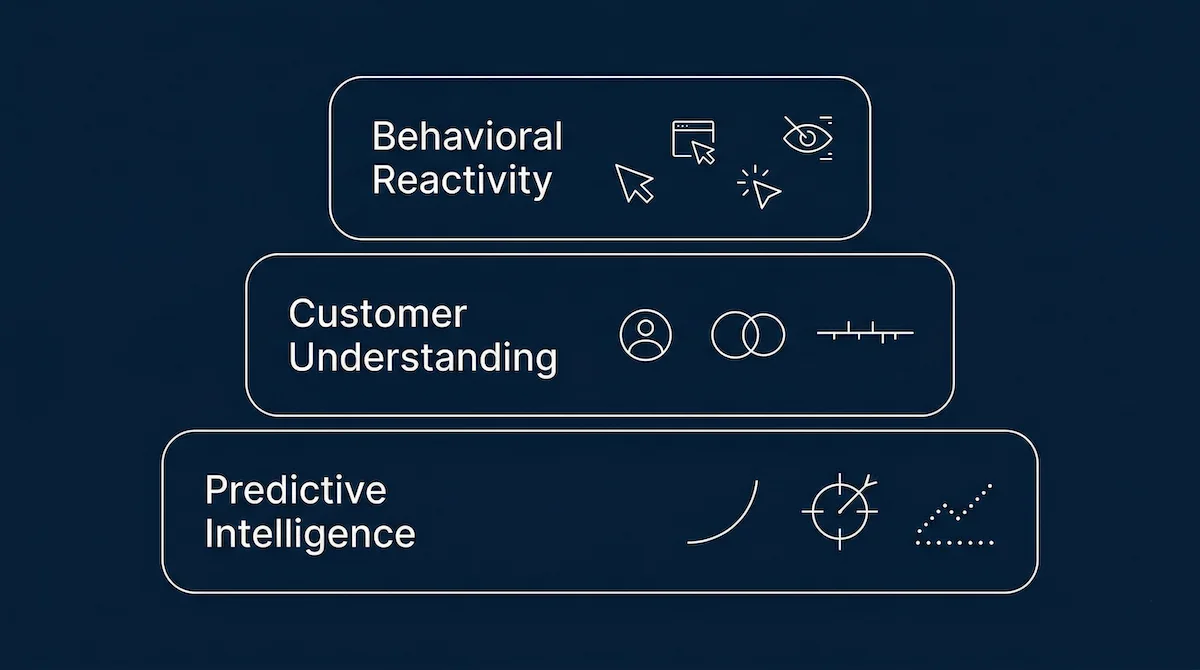
The three layers of data driven personalization
Think of personalization as three distinct layers, each building on the one below. You can implement them sequentially — and most stores should.
Layer 1: Behavioral reactivity
This is the foundation. Your system reacts to what a customer does in real time.
A customer views a product → show related products. A customer searches for “running shoes” → personalize the results based on their previous interactions. A customer abandons a cart → send a reminder email with the abandoned products.
Behavioral reactivity requires three things:
- Event tracking — capturing page views, searches, add-to-cart actions, and purchases in real time
- A recommendation layer that can process those events and return relevant products
- Touchpoint integration — connecting the recommendation layer to your website, email platform, and search
Most modern ecommerce platforms provide basic behavioral reactivity out of the box. The ceiling is low, but it’s the right place to start because the implementation effort is manageable and the ROI is immediate.
Layer 2: Customer understanding
This is where personalization gets meaningfully better. Instead of just reacting to the latest click, the system builds a persistent understanding of each customer.
Customer understanding means knowing that this particular visitor prefers premium brands, typically shops for herself and her daughter, tends to buy during sales events, and has a complete wardrobe of outdoor gear except for winter accessories.
This layer requires:
- Cross-session identity — connecting behavior across visits, devices, and channels
- Preference modeling — inferring preferences from behavioral patterns, not just explicit actions
- Segment intelligence — understanding where each customer falls in lifecycle, value, and interest dimensions
Building customer understanding at scale requires processing behavioral data from many sources and connecting it to product-level attributes.
Layer 3: Predictive intelligence
The most advanced layer. Instead of reacting to what customers did or understanding what they like, the system predicts what they’ll do next.
Predictive intelligence means anticipating that a customer who bought a tent last month will need sleeping bags and camp cookware within the next few weeks — and surfacing those products before the customer searches for them.
This layer requires:
- Sufficient data volume — predictions need large datasets to be accurate
- Product lifecycle awareness — understanding replenishment cycles, complementary purchase timing, and seasonal patterns
- Collective intelligence — learning from patterns across many customers and stores, not just your own data
Most mid-market stores can’t reach Layer 3 with their own data alone. This is where product intelligence platforms become valuable — borrowing intelligence from aggregated behavioral patterns across an ecosystem of similar stores.
The data you actually need
Ecommerce teams often assume data driven personalization requires a data warehouse, a team of analysts, and months of setup. It doesn’t.
Here’s the minimum dataset that makes each layer work:
For Layer 1 (Behavioral reactivity):
- Page view events (product ID + timestamp)
- Search queries (query text + results clicked)
- Add-to-cart events (product ID + quantity)
- Purchase events (order ID + products + amounts)
For Layer 2 (Customer understanding):
- Everything in Layer 1, plus:
- Customer identity across sessions (email, account, or persistent cookie)
- Purchase history with dates and amounts
- Email engagement data (opens, clicks)
For Layer 3 (Predictive intelligence):
- Everything in Layers 1-2, plus:
- Product attribute data (materials, styles, use cases, price points)
- Inventory data (stock levels, incoming supply)
- External signals (seasonality, market trends)
The key insight is that Layers 1 and 2 use data you’re almost certainly already collecting. You probably just aren’t connecting it to your personalization touchpoints.
Common failure modes
The “spray and pray” approach
Installing a recommendation widget on every page with default settings isn’t data driven personalization. It’s decoration. The widget shows “bestsellers” to everyone because there’s no behavioral data feeding it, or the data connection was never properly configured.
The “data hoarding” approach
Collecting every possible data point without a clear personalization use case. You end up with terabytes of event data in a warehouse, a monthly analytics report that nobody reads, and the same generic shopping experience you started with.
The “segment everything” approach
Creating dozens of customer segments (high-value winter shoppers who prefer organic products and live in urban areas) sounds sophisticated but produces tiny audiences that don’t have enough statistical weight to personalize meaningfully. Start with 3-5 broad segments and let algorithmic personalization handle the nuance within each.
The “one channel” approach
Personalizing the website but sending generic emails. Or personalizing emails but showing the same homepage to everyone. Customers experience your brand across channels. If the personalization doesn’t follow them, it feels inconsistent.
Building your stack
A practical data driven personalization stack for a mid-market ecommerce store looks like this:
-
Event collection layer — A JavaScript snippet or tag manager configuration that captures behavioral events and sends them to your personalization platform. This is non-negotiable.
-
Personalization engine — The system that processes behavioral data and product data to generate recommendations and personalized experiences. This is the core of the stack.
-
Touchpoint connectors — Integrations that deliver personalized experiences to your website (search, recommendations), email platform, and other customer-facing channels.
-
Product data feed — A structured feed of your product catalog with attributes, pricing, and availability. This is the raw material that the personalization engine works with.
The good news is that integrated platforms like Hello Retail bundle items 2-4 together, which means you don’t need to build and maintain separate integrations for each layer.
How this connects to Hello Retail
Hello Retail’s approach to data driven personalization maps directly to the three-layer framework. The Product Intelligence engine handles customer understanding and predictive intelligence. The Search and Recommendations products deliver personalized experiences across touchpoints. And Product Agents extend personalization to the inbox.
What makes the approach practical for mid-market stores is the collective intelligence layer — behavioral patterns learned across the Hello Retail network accelerate personalization quality without requiring massive individual store datasets.
Key takeaways
- Data driven personalization has three layers: behavioral reactivity, customer understanding, and predictive intelligence — implement them sequentially
- You already have most of the data you need for Layers 1 and 2 — the gap is in connecting it to personalization touchpoints
- Avoid common failure modes: decoration widgets, data hoarding without action, over-segmentation, and single-channel personalization
- Collective intelligence solves the data volume problem for mid-market stores, making Layer 3 accessible without enterprise-scale traffic