
Product lifetime value (PLTV): The ecommerce metric your competitors aren't tracking

Most ecommerce teams know their customer lifetime value. Fewer know which products are responsible for creating that lifetime value in the first place.
That’s the gap Product Lifetime Value (PLTV) fills. Instead of asking “how much is this customer worth?”, PLTV asks “how much downstream revenue does this product generate after it’s been purchased?”
The difference matters. A garden chair that costs 200 euros might look like a single transaction. But if 25% of chair buyers come back for umbrellas, and 15% come back for blankets, that chair is actually a 247-euro revenue event. PLTV captures the hidden value that a price tag alone misses.
What is product lifetime value?
Product Lifetime Value is a metric that measures the total additional revenue a product generates after its initial purchase. It’s calculated from the prices of all subsequent products purchased by buyers of the original product, weighted by the probability of each follow-on purchase.
PLTV is a practical application of Hello Retail’s Product Intelligence engine, which uses advanced clustering techniques to identify product correlations across the entire Hello Retail network. Rather than tracking individual customers, it tracks product purchase sequences, making it inherently privacy-safe, since it works with aggregate product-level patterns rather than personal data.
PLTV vs. CLV: When to use each
These two metrics sound similar but answer different questions. Here’s how they compare:
| PLTV | CLV | |
|---|---|---|
| Unit of analysis | Product or product cluster | Individual customer |
| What it measures | Downstream revenue a product generates | Total revenue from a customer over time |
| Data required | Product purchase sequences (aggregate) | Customer identity + full purchase history |
| Privacy impact | Low (works with product-level data, no PII needed) | High (requires tracking individual behavior) |
| Best for | Marketing spend allocation, product assortment, merchandise planning | Retention strategy, customer segmentation |
| Time horizon | Product catalog lifecycle | Individual customer relationship |
| Who owns it | Merchandising, growth, marketing | CRM, customer success |
When to use PLTV: You want to decide which products deserve more ad spend, which to feature in acquisition campaigns, and which to stock deeper. You care about products as revenue drivers, not just price tags.
When to use CLV: You want to segment customers, personalize retention campaigns, or forecast revenue from existing customer cohorts.
The most effective ecommerce teams use both. CLV tells you which customers to invest in. PLTV tells you which products to lead with to create those high-value customers.
How PLTV is calculated
To understand how PLTV works, let’s walk through a simplified product journey. The evaluated product profile is based on Hello Retail’s product clustering techniques, which identify correlations among a vast array of products using Product Intelligence. For this example, we’ll look at the PLTV calculation for a cluster of similar garden chairs.
Note: the actual calculation involves significantly more complex processes. This is a simplified illustration to make the concept accessible.
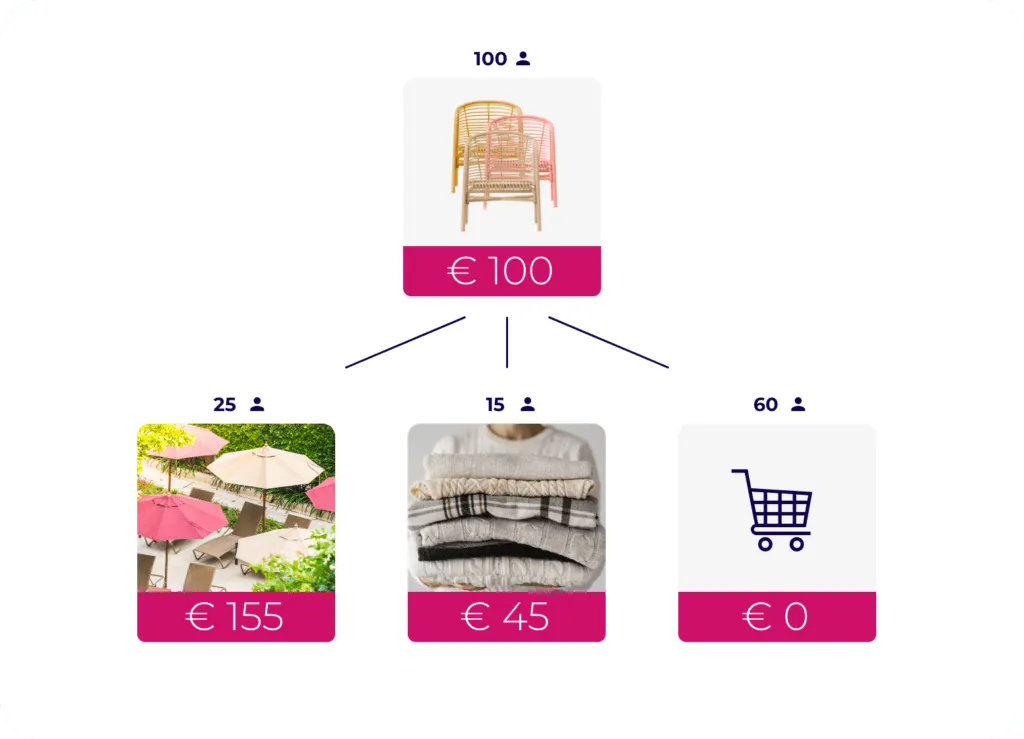
Step 1: Identify follow-on purchases
Suppose the data shows 100 customers purchased chairs from the same product cluster. Of those:
- 25 customers returned later and bought garden umbrellas (155 euros average)
- 15 customers returned later and bought blankets (45 euros average)
- The remaining 60 customers made no additional purchases
Step 2: Calculate first-level PLTV
The PLTV of the chair cluster is the weighted sum of follow-on revenue:
25% x 155 euros + 15% x 45 euros + 0 euros = approximately 46 euros
That means every chair purchase generates, on average, an additional 46 euros in downstream revenue.
Step 3: Add subsequent purchase layers
Now suppose 5 of the 25 umbrella buyers later returned to purchase outdoor plants (29 euros average).
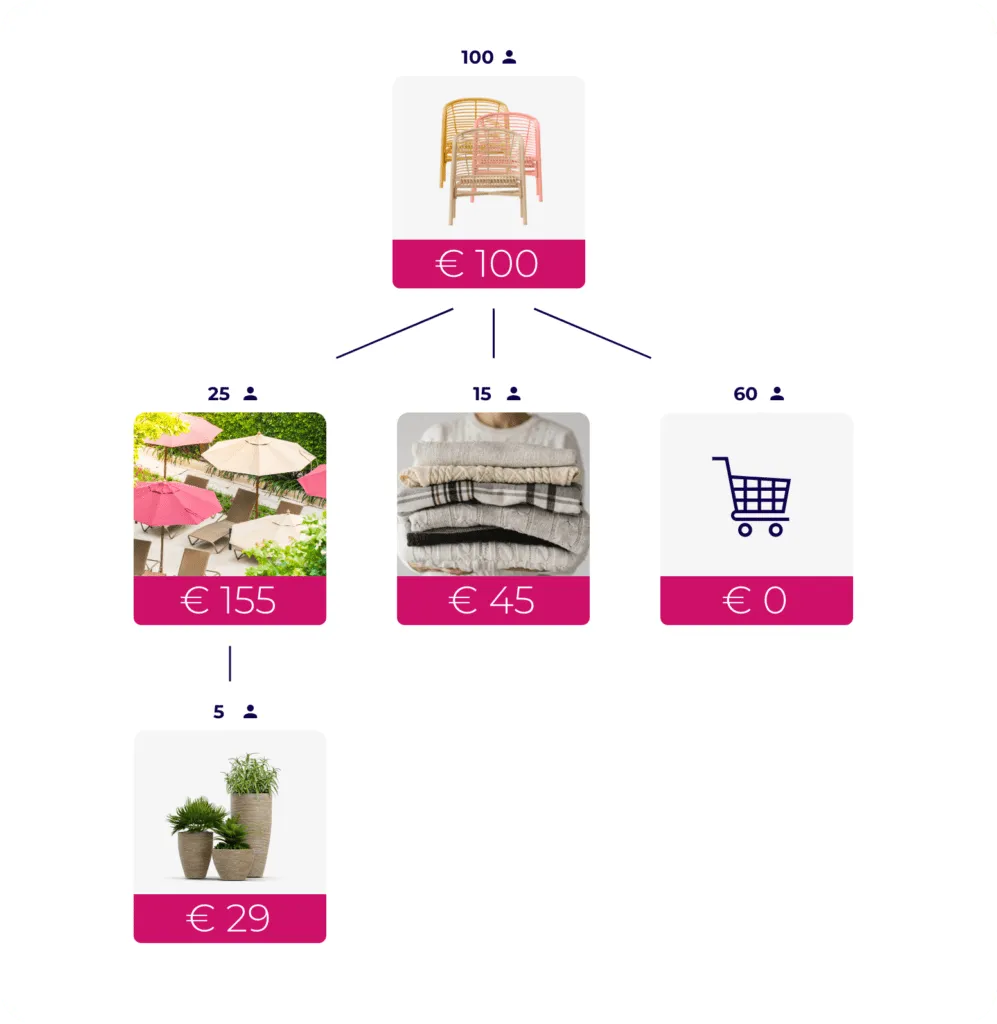
The calculation extends to include this second layer, using the percentage relative to the umbrella buyers:
25% x 155 euros + 15% x 45 euros + 20% x 25% x 29 euros = approximately 47 euros
The same process continues for all subsequent connected purchases until there are no more linked transactions.
Why the original product price is excluded
PLTV deliberately excludes the price of the evaluated product itself. If it were included, expensive products would always show a high PLTV even if they generated zero follow-on purchases. That would be misleading. The point of PLTV is to measure the additional revenue a product unlocks, not the revenue from its own sale.
How to use PLTV in practice
PLTV becomes powerful when you move from “interesting metric” to “decision driver.” Here are the specific ways ecommerce teams put it to work.
SKU-level marketing prioritization
Not all products deserve equal ad spend. A product with a 200-euro price tag and a 5-euro PLTV is a one-and-done transaction. A product with a 50-euro price tag and a 90-euro PLTV is a relationship starter.
Use PLTV to:
- Reallocate paid media budgets toward high-PLTV products. These products pay back more than their initial conversion is worth, so you can afford higher cost-per-acquisition.
- Design acquisition campaigns around gateway products, the items that reliably lead to repeat purchases.
- Identify underperforming catalog segments where products have low PLTV despite high sales volume. These might need better cross-sell or bundling strategies.
Channel-specific bid adjustments
Different marketing channels perform differently for high-PLTV vs. low-PLTV products:
- Paid search and shopping ads: Increase bids on high-PLTV products. The initial CPA looks expensive, but the downstream revenue justifies it. A product that costs 30 euros to acquire but generates 80 euros in PLTV has a very different ROI profile than one with zero follow-on revenue.
- Email marketing: Feature high-PLTV products in welcome sequences and win-back campaigns. These are the products most likely to start a purchase chain.
- Retargeting: Prioritize retargeting budgets toward shoppers who viewed high-PLTV products. Their potential value is higher than the initial conversion suggests.
- Loyalty programs: Use PLTV data to design loyalty tier thresholds and rewards. Customers who bought high-PLTV products are already more likely to return, and loyalty incentives can accelerate that behavior.
CAC payback and LTV:CAC framing
PLTV changes how you think about customer acquisition cost (CAC):
Without PLTV: You compare CAC against the first-order value. If it costs 40 euros to acquire a customer who buys a 50-euro product, the margin looks thin.
With PLTV: You compare CAC against first-order value plus expected downstream revenue. If that 50-euro product has a PLTV of 60 euros, the effective revenue is 110 euros, and the CAC looks much more reasonable.
This framing is especially useful when justifying acquisition spend to stakeholders. “This product costs us 40 euros to sell but generates 110 euros in total revenue” is a more complete picture than “this product has a 20% margin on first purchase.”
Merchandise and assortment planning
PLTV insights inform product catalog decisions:
- Stock depth: Products with high PLTV deserve deeper inventory. Running out of a gateway product doesn’t just cost you one sale. It costs you the entire downstream chain.
- New product evaluation: When introducing new products, look at the PLTV of similar product clusters. A new product that fits into a high-PLTV cluster is likely to generate strong follow-on revenue.
- Seasonal planning: Some products have seasonal PLTV patterns. A barbecue grill purchased in spring might have a very different PLTV profile than one purchased in autumn, because the follow-on purchase window differs.
How Product Intelligence powers PLTV
PLTV isn’t something you can calculate from a standard analytics tool. It requires understanding product relationships at scale: which products are similar, which purchase sequences are meaningful, and which correlations are noise.
Hello Retail’s Product Intelligence engine handles this by building product clusters: groups of similar products identified through AI analysis of product attributes, catalog structure, and purchase patterns across the Hello Retail network. This clustering is what makes PLTV practical. Instead of trying to calculate lifetime value for every individual SKU, you calculate it for product clusters, which provides statistically robust results even for products with limited individual purchase history. You can browse the clusters and underlying signals for any catalog in the Product Intelligence Explorer.
To learn more about the technology behind product clustering and Product Intelligence, read The future of ecommerce and A paradigm shift in product understanding.
Getting started with PLTV
Product Lifetime Value is available as one of Hello Retail’s Product Intelligence API data points. If you want to see PLTV data for your own product catalog, the fastest way to get started is to book a demo, where we can show you what your highest-PLTV products are and where the biggest opportunities lie.
For more on how product-centric data analysis is changing ecommerce, explore our Product Intelligence insights or read about how product data drives retail intelligence.
Keep reading
 Product Intelligence
Smarter discount distribution
Use data analysis to understand discount distribution across product types and optimize your promotional strategy.
 Product Intelligence
Unlock Important Insights into Recurring Products
Predict when customers will re-purchase recurring products and time your marketing to match their buying cycle.
