
Product recommendation statistics: 17 numbers on cross-sell, AOV, and conversion
Product recommendation statistics: The numbers behind cross-sell, AOV, and conversion
Product recommendations are one of the few ecommerce features that pay for themselves in revenue you can measure. A shopper who clicks “you might also like” is telling you what they want next, and the data shows that shoppers who engage with recommendations convert at rates that dwarf those who never do.
Yet many ecommerce teams still treat recommendation widgets as decoration: a row of products dropped onto the homepage and left to run. The product recommendation statistics in this guide tell a consistent story. Recommendations are a revenue engine, the gap between a generic carousel and a personalized one is large, and the lift is concentrated in a small share of visits that punch far above their weight.
How much revenue product recommendations drive
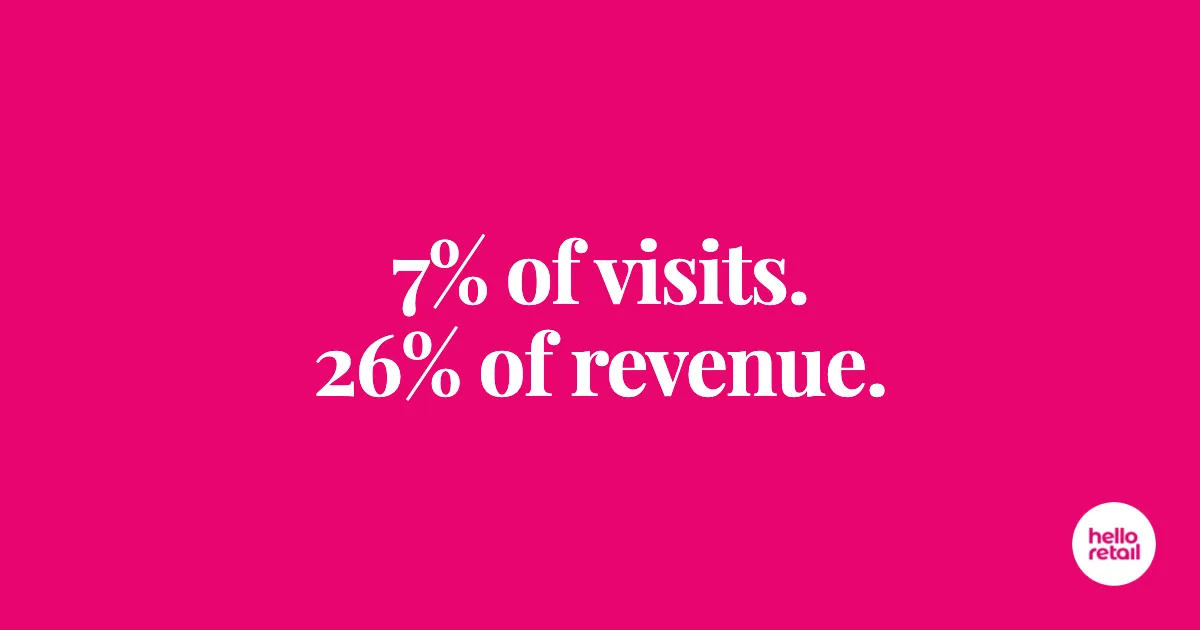
The headline number first. In a Salesforce study of 150 million shopping sessions, visits where the shopper clicked a recommendation made up just 7% of traffic but accounted for 26% of revenue. That is the core paradox of recommendations: a small slice of engaged visits drives roughly a quarter of the money.
Barilliance, reporting on its own platform data, puts the ceiling higher still: product recommendations can account for up to 31% of ecommerce site revenue. On average across its customers, 12% of sales were attributed to recommended products.
The most-cited figure of all is older. A 2013 McKinsey estimate attributed 35% of Amazon’s purchases to its recommendation system. It is a decade-old number and should be read as a directional estimate rather than a current benchmark, but it is the statistic that put recommendations on the map, and the direction it pointed has held up in every study since.
Cross-sell and upsell performance
Recommendations are how cross-sell and upsell happen at scale. Instead of relying on a merchandiser to hand-pick “frequently bought together” pairings, a recommendation engine surfaces the complementary product automatically, on every product page, for every shopper.
The Salesforce data shows the mechanism clearly. Shoppers who clicked a recommendation were 24% more likely to add an item to their cart. On tablet, the add-to-cart lift reached 31%. The recommendation is doing the work a good salesperson does on a shop floor: noticing what you are looking at and pointing you toward the thing that completes the purchase.
The compounding effect matters. A shopper who adds a recommended item is not just spending more on this order. They are training the engine, and the next set of recommendations gets sharper.
Recommendations and average order value
Average order value is where cross-sell shows up on the invoice. Salesforce found that visits including a recommendation click carried a 10.3% higher average order value across all devices, rising to 15.2% on tablet.
Barilliance reported an even larger swing on its platform: from a baseline average order value of $44.41 on sessions with no recommendation engagement, the figure multiplied once prospects engaged with a single recommendation. The exact multiple depends on catalog and price points, but the direction is unambiguous. Engaged shoppers spend more.
Per-visit spend tells the same story from another angle. In the Salesforce study, the per-visit spend of a shopper who clicked a recommendation was roughly five times higher than a shopper who did not.
Conversion lift from personalized recommendations
This is the statistic that makes the business case on its own. In the Salesforce study, shoppers who clicked a recommendation converted 4.6x more often than shoppers who did not. The lift was 4.3x on desktop and held strong across mobile devices.
Barilliance measured the same effect on first interaction: conversion rate increased by 288% after a single recommendation engagement, from a baseline of 1.02% for sessions with no engagement.
Personalization is what separates these numbers from a generic “best sellers” row. Studies consistently find that personalized recommendations outperform generic ones by a wide margin, because a recommendation tuned to the individual shopper’s behavior is answering a question that shopper is actually asking.
Where recommendations work: Homepage, product page, cart, and email
Placement decides performance. The same engine produces very different results depending on where the recommendation appears and whether the shopper can see it.
Barilliance found that recommendation widgets placed above the fold were 1.7x as effective as those placed below the fold. Visibility is not a detail. A recommendation a shopper never scrolls to is a recommendation that never converts.
The highest-intent placements are the product page and the cart. On the product page, the shopper has already signaled interest in a category, so complementary and alternative recommendations land naturally. In the cart, “complete the look” and accessory recommendations capture the upsell at the moment of highest purchase intent.
Email is the placement teams most often underuse. Recommendations embedded in Triggered Emails carry the personalization signal out of the session and back to the shopper, surfacing the products most likely to bring them back.
The cost of bad or generic recommendations
Not all recommendations help. A generic carousel of best sellers, identical for every visitor, leaves most of the lift on the table.
The clearest evidence is the gap between personalized and generic recommendations. Across studies, personalized recommendations consistently outperform “popular” or “best selling” rows, because relevance is what drives the click. A recommendation that ignores what the shopper has just viewed is competing with the rest of the page for attention and usually loses.
There is a retention cost too. Salesforce found that 37% of shoppers who clicked a recommendation on their first visit returned to the site, compared with just 19% of shoppers who did not click one. Relevant recommendations do not only lift the current order. They make the shopper more likely to come back at all.
AI vs rule-based recommendations: The numbers
The shift from manual, rule-based recommendation logic to AI-driven ranking is producing measurable gains, and it is the difference between recommendations that decay and recommendations that improve.
Rule-based systems depend on a merchandiser writing and maintaining the rules: if viewed X, show Y. They are brittle, they go stale as the catalog changes, and they cannot personalize to the individual. AI-driven engines rank products per shopper using behavioral signals, so the recommendation adapts to each visitor and updates itself as behavior shifts.
The compound effect is the real advantage. Better relevance produces more clicks, more clicks generate more behavioral data, and more data sharpens the next recommendation. That flywheel is why AI recommendations widen their lead over static rules the longer they run. Broad personalization benchmarks point the same way: McKinsey research, widely cited by personalization vendors, finds that personalization typically lifts revenue by 10% to 15%, and as much as 25% for the businesses that execute it best.
What to measure: Recommendation metrics that matter
The statistics above are industry benchmarks. What matters more is your own recommendation data. Five metrics give you a complete picture.
-
Recommendation click-through rate. What share of shoppers who see a recommendation click it? A low rate usually means the recommendations are generic or poorly placed.
-
Revenue from recommendations. The share of total revenue attributable to sessions that included a recommendation click. This is the north star that connects recommendation quality to the bottom line.
-
Recommendation-attributed AOV. Compare average order value on recommendation-engaged sessions against sessions with no engagement. The gap tells you how hard your cross-sell is working.
-
Conversion rate, engaged vs not. The ratio between conversion on recommendation-engaged visits and the rest. This is the single clearest measure of recommendation value.
-
Return rate of recommendation-clickers. How many first-time recommendation-clickers come back? Recommendations that drive retention are worth more than their first-order lift suggests.
Tracking these over time beats any single snapshot. A falling recommendation click-through rate can be an early warning that your relevance is degrading as the catalog grows.
How Hello Retail approaches recommendations
Hello Retail’s Product Recommendations are built on the principle that a recommendation should reflect the individual shopper, not the average one. The engine ranks products per shopper using behavioral signals, so two visitors looking at the same product page see different complementary products based on their own browsing and purchase history.
This is powered by the Product Intelligence engine, which maintains a real-time understanding of every product in the catalog and how shoppers interact with it. In practice that means:
-
Per-shopper ranking. Recommendations adapt to each visitor’s behavior rather than serving the same best-seller row to everyone.
-
Per-placement configuration. Recommendations are configurable per placement, so the logic on a product page can differ from the cart or the homepage and each placement is tuned to its intent.
-
Search-to-recommendation continuity. Because Hello Retail unifies search and recommendations on the same intelligence layer, what a shopper searches for informs what they are recommended everywhere else.
-
Recommendations in email. The same engine powers the product blocks in emails sent by Product Agents, carrying personalization beyond the session.
The result is a recommendation experience that improves over time, because every interaction feeds back into the engine that powers it.
Key takeaways
- Recommendation engagement is concentrated: in Salesforce data, 7% of visits drive 26% of revenue, so the lift comes from a small, high-value slice of traffic
- Shoppers who click a recommendation convert 4.6x more often and spend roughly 10% more per order
- Personalized recommendations consistently outperform generic best-seller rows, and placement matters: above-the-fold widgets are 1.7x as effective
- Recommendations drive retention, not just the current order: 37% of first-visit clickers return vs 19% who do not
- AI-driven, per-shopper ranking widens its lead over static rules over time, because every interaction sharpens the next recommendation
Product recommendation statistics point in one direction: recommendations are where a shopper’s next purchase is decided. The question is not whether to run them, but how much revenue a generic carousel is leaving on the table.
A generic carousel and a personalized one cost the same to run. Book a demo to see the difference on your own catalog.
Keep reading
Product Recommendations Product recommendation statistics: 17 numbers on cross-sell, AOV, and conversion
Shoppers who click a recommendation convert 4.6x more often and account for 26% of revenue from just 7% of visits (Salesforce). The full 2026 dataset on why recommendations drive ecommerce growth.
 Product Recommendations
 Ecommerce personalization trends 2026
The personalization trends that matter aren't the flashy ones. Here's what's actually moving the needle for ecommerce teams in 2026.
 Product Recommendations
 Personalization strategies for SMB ecommerce
You don't need enterprise budgets to personalize effectively. Here are the personalization strategies that work for small and mid-market ecommerce stores.