
NLP search for ecommerce: How it actually drives revenue, and how to measure it
NLP search for ecommerce: How it actually drives revenue, and how to measure it
Natural language processing in ecommerce search is one of those topics where vendor marketing and merchant reality drift apart. Vendors talk about transformer architectures and embedding models. Merchants want to know whether NLP search converts better than keyword search, by how much, and how to measure the difference.
This post is the practical translation. What NLP search actually does inside a shopper’s session, which metrics distinguish a real revenue lift from noise, and how to test the change on a live Shopify or Magento store without committing to a six-month replatform.
What NLP search is, in one paragraph
NLP search for ecommerce is search that interprets the shopper’s intent rather than matching keywords literally. It handles misspellings, partial terms, synonyms, attribute filters expressed in natural language (“warm jacket for hiking”, “running shoes size 10 mens”), and behavioral signals like prior browsing and category affinity. The shopper types whatever comes to mind. The search engine returns the products the shopper actually wants, ranked by predicted relevance. The gap between “type the exact keyword the merchandiser thought of” and “type what you mean” is the revenue gap.
Why this matters, with one stat worth keeping
Visitors who use site search convert at roughly 1.8x the site average. Econsultancy puts the average at 4.63% for searchers versus 2.77% for non-searchers. Even though searchers are usually a minority of visitors, they account for a disproportionate share of revenue because they self-select for purchase intent. Source: /en/learn/ecommerce-site-search/.
A search bar that returns the wrong products to high-intent shoppers does not lose a small fraction of revenue. It loses the most valuable fraction. NLP is the layer that decides whether the search bar earns the conversion or breaks the trust.
What NLP search actually does in a session
Six things, in order:
- Corrects typos and partial input. “Runnign shoes size 10 mens” becomes a structured query for men’s running shoes in size 10. The shopper does not see the correction. The shopper sees the right products.
- Expands synonyms automatically. A shopper searching “trousers” sees the products tagged “pants” without anyone manually mapping the synonym. AI synonyms fix zero-result searches before they become bounces.
- Parses attribute language. “Warm jacket for hiking” is decomposed into the attributes that matter: jacket category, warmth-coded materials (down, wool, fleece), outdoor use case. The engine ranks products that match the most attributes highest.
- Applies behavioral relevance. A shopper who has been browsing premium brands all session sees premium results first when they search for “shoes”. A bargain-driven shopper sees sale items first for the same query. Same search, different ranking, more revenue.
- Handles cold-start gracefully. A first-time visitor with no behavioral history still gets meaningful results. The engine uses product attributes and catalog-level relevance instead of refusing to rank.
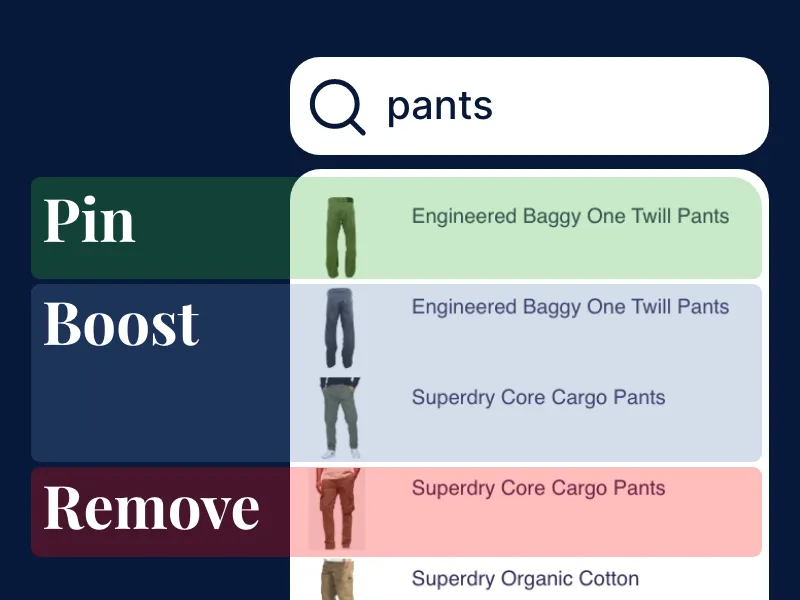
- Lets merchandisers override the AI when business rules demand it. Boost the new collection. Bury the discontinued SKU. Pin the campaign hero. Without this layer, “AI-powered search” becomes a black box merchandisers cannot direct.
The first five are technical capabilities. The sixth is the one that decides whether the system is operationally adoptable. Merchandiser control is what separates a search platform from a search API.
The metrics that distinguish lift from noise
A search vendor demo will show you any of these in the right light. The numbers that prove a real revenue impact look like this:
| Metric | What it measures | What to track |
|---|---|---|
| Search-to-conversion rate | Sessions with a search that ended in purchase | Should rise materially after NLP rollout. Compare against the non-search baseline. |
| Zero-result rate | Searches that returned no products | Should drop toward zero. A 10% zero-result rate is leaving revenue on the table. |
| Click-through rate on first result | Whether the top-ranked product was the right one | Should rise. Tracks ranking quality beyond simple match. |
| Average search depth | How far down the results page shoppers scroll before clicking | Should drop. Shorter depth means stronger top-rank relevance. |
| Revenue per searcher | Total revenue divided by searching sessions | The headline number. The one the CFO cares about. |
| Bounce rate after search | Shoppers who searched and left without engaging | Should drop. Hello Retail customers see up to a 55% reduction. Source: /en/search/ |
| Conversion lift vs baseline | Searcher conversion vs site-average conversion | Should hold the Econsultancy ~1.8x or improve it. Personalized NLP search has shown 76% conversion improvement. Source: /en/search/ |
Two of these matter more than the others for ROI conversations. Revenue per searcher is the headline. Zero-result rate is the diagnostic. If it is above 5%, NLP search is going to move the needle regardless of which other metrics look fine.
How to test NLP search without a replatform
The trap on enterprise search projects is the all-or-nothing rollout. NLP search can be tested incrementally:
- Baseline first. Pull 30 days of current search data: zero-result rate, search-to-conversion, revenue per searcher, the top 50 searched queries by volume. Do not skip this. Without baseline, “AI improved search” is a claim, not a measurement.
- Pilot on a single category or locale. Many platforms support running a new search experience on a single product category, a single store, or a single percentage of traffic. Pilot before whole-store rollout.
- A/B split traffic. Split 50/50 between the old search and the new. Measure the same metrics on both halves for 14 to 28 days. Statistical confidence on conversion rate typically needs at least 1,000 search sessions per arm, more for low-volume stores.
- Inspect the bottom of the funnel. A search platform that improves CTR but does not improve revenue is suspicious. Verify the lift carries through to checkout, beyond clicks alone.
- Check zero-result reduction specifically. This is the single most attributable win. A drop from 12% to 1% zero-result rate, on a store with 50,000 monthly searchers, is a measurable amount of recovered revenue. Quantify it before signing the contract.
Steps 1 to 3 are platform-agnostic. They work whether the new search is Hello Retail, Algolia, Coveo, or Klevu. Step 5 is the cleanest single-test win to put in front of the buying committee.
How NLP search ties into the rest of the personalization stack
Search does not live alone on a Shopify or Magento store. The shopper who searches for “running shoes” is the same shopper who then sees Product Recommendations on the product page, receives a Triggered Email if they abandon, and is shown personalized Newsletter Content the next week.
The integration question matters. A search platform that does not share intent signals with the recommendation layer is really just keyword matching in different clothes, well short of true personalization. Hello Retail’s stack uses one shared intelligence layer (Product Intelligence) across Search, Recommendations, Email, and Retail Media. The shopper who searched for “running shoes” tells the recommendation engine what to surface on the product page they land on, which tells the triggered email what to recommend if they leave. One identity, one signal flow, one revenue compounding effect.
What buyers should ask vendors before signing
- What is your zero-result rate on a typical mid-market catalog of 5,000-50,000 SKUs?
- How are synonyms managed: hand-curated lists, AI-generated, or both?
- Can merchandisers override AI ranking from a dashboard without filing a developer ticket?
- What is the integration time from API key to live search results on a Shopify store?
- Does the same intelligence layer power your recommendations and email products, or are those separate stacks?
- What does the data export look like for revenue attribution to specific search queries?
If any of these requires a sales call to answer, that itself is the answer.
FAQ
What is NLP search for ecommerce? NLP search uses natural language processing to interpret shopper intent rather than matching keywords literally. It handles misspellings, synonyms, attribute parsing (“warm jacket for hiking”), and behavioral relevance. The shopper types whatever comes to mind and the search engine returns the products they actually want.
How much does NLP search improve conversion rates? Visitors who use site search already convert at roughly 1.8x the site average per Econsultancy. Adding personalized NLP search on top of keyword search has shown a 76% improvement in conversion rates on Hello Retail Search specifically. Source: /en/search/. Lift on a specific store depends on baseline zero-result rate and current search quality.
What’s the difference between AI search and NLP search? “AI search” is the broader category and “NLP search” is one component. AI search typically combines NLP (intent interpretation), behavioral relevance (personalization), and merchandising rules (business control). Pure NLP without behavioral signals is rare in production ecommerce.
Do I need to replatform to add NLP search? No. Most modern NLP search platforms integrate with existing Shopify, Magento, WooCommerce, and Shopware stores via a JavaScript snippet or API integration. Implementation timelines are typically 4 to 8 weeks, not 6 months. Pilot on a single category before committing to whole-store rollout.
How do I measure the revenue impact of NLP search? Track six metrics against a 30-day baseline before rollout: zero-result rate, search-to-conversion rate, click-through on first result, average search depth, bounce after search, and the headline number, revenue per searcher. A/B split traffic between old and new search for 14-28 days. Need at least 1,000 search sessions per arm for statistical confidence on conversion rate.
Does NLP search replace merchandising rules? No. NLP handles intent interpretation. Merchandising rules handle business overrides: boost the new collection, bury the discontinued SKU, pin the campaign hero. A search platform without merchandiser dashboard control is operationally undeployable for most ecommerce teams.
Hello Retail’s Search combines NLP-powered relevance with full merchandiser control across Shopify, Magento, WooCommerce, and custom platforms. Built on the same Product Intelligence engine that powers recommendations and email. Read more in the ecommerce search buyer’s guide.
Last updated: 2026-05-12.
Keep reading
 Search
 Plant nursery beats tech giants at personalization
A Danish plant nursery built search around when flowers bloom. Most ecommerce sites still serve the same results to everyone. The lift speaks for itself.
 Search
 Search Word Boosts: Precise Ecommerce Search Optimization
Control how products appear in search results for specific keywords. You can now pin, exclude, or boost products based on attributes like brand or category.