
DTAILS: The Shopify Plus agency built by merchants, for merchants

The founding story of DTAILS is specific enough to matter. In 2013, Kim Eriksen moved his own webshop, morfars.dk, to Shopify. Shopify’s then-Partner Manager noticed the work and invited him to join the partner program. Three years later, he formally founded DTAILS as the agency he had wished had existed when he was still the customer: “the consultancy I myself dream of being a customer with,” as he describes it.
That is a claim many agencies make in different forms. What gives it traction at DTAILS is that it is structural, not anecdotal. The entire customer-facing team has personally run webshops. They have lived the decisions that ecommerce managers make daily: what to tune in the search configuration, where a 2% conversion drop is a product-data problem versus a UX problem, when a platform limitation is genuinely a platform ceiling versus a configuration gap that can be closed.
DTAILS has been a Hello Retail partner since 2018, with 9+ shared clients across markets from Scandinavia to Korea. This is a profile of what they build, how they approach it, and where the two platforms fit together.
Who DTAILS is

Founded in 2016, DTAILS operates from two locations: Copenhagen (Nørrebro) and Skanderborg. The team numbers over 35 dedicated Shopify specialists. They are Shopify’s first Shopify Plus Partner in the Nordic region, a position that gives them a track record in the regional market and visibility into the Shopify roadmap earlier than most agencies.
In 2023, DTAILS received the Børsen Gazelle award, Denmark’s recognition for fast-growing businesses. On the Shopify Partners Directory, they hold a 5.0 rating across 25 reviews, the highest available score.
CEO Peter Sommer joined from IBM’s consulting practice. The combination of enterprise advisory work and platform-native ecommerce shapes how DTAILS handles larger transformation projects where the business case extends well beyond a storefront redesign.
Work at DTAILS is driven by values of integrity, professionalism, and quality. At scale, that translates to a willingness to tell customers when their roadmap is wrong, when they are not operationally ready for what they are asking to be built, and when a different tool is the better answer.
What “born on the other side of the table” produces operationally
Shopify releases over 100 new features every six months. The work for any serious implementation partner is not to implement everything. The work is to filter: which features apply to which merchant, in which market, at which stage of growth.
That filtering requires the kind of judgment that comes from having actually operated a webshop, not from reading release notes.
As Peter Sommer described it in his conversation with Hello Retail: “We take great pride that we have all been born on the other side of the table. So when they get new features, they can quite fast find out what’s relevant for this market, what’s relevant for that particular industry or customer.”
The practical output of that filtering is visible across DTAILS client projects. They identify migration readiness before a contract is signed, recommend only the integrations that solve actual operational bottlenecks, and flag when a customer’s internal team is not yet equipped to operate what the agency is about to build. Those are merchant-side judgments, not platform-side ones.
What they build
Platform migrations: The core competency
The list of source platforms DTAILS has migrated merchants away from covers most of what Nordic mid-market ecommerce has accumulated over two decades: Magento, WooCommerce, DanDomain, Salesforce Commerce Cloud, Centra, Umbraco, DynamicWeb.
These are not cosmetic relaunches. They involve data architecture decisions, legacy integration teardown, and the process changes that arrive when a merchant’s operations team switches platforms after years of accumulated workarounds. The financial logic Peter Sommer describes from client conversations is consistent: merchants arrive spending 80% of their IT budget on maintaining an existing platform and 20% on new features. The stated ambition is to invert that ratio. DTAILS’ role is to manage the transition in a way that does not lose business performance in the process.
Notable recent projects include Seniorshop.dk, which expanded to 13 European markets post-migration, and Ismageriet, which required a custom production-system integration built alongside the platform move. The Luksusbaby project, detailed below, migrated six storefronts simultaneously.
B2B ecommerce on Shopify Plus
B2B is a genuine DTAILS specialization, not a ticked box on a service page. Their implementation work in this area covers the full operational range:
- Buyer-specific pricing tiers and net payment terms
- Order approval workflows for procurement-controlled purchasing
- Dedicated wholesale portals with login-gated catalogue access
- Integration with Microsoft Dynamics 365 Business Central for ERP connectivity
The FRAMA case (Centra to Shopify Plus B2B) and AV CENTER (Umbraco to Shopify Plus B2B) are representative of this work. Both required wholesale logic that Shopify Plus natively supports but that still needs considered configuration and integration work to operate correctly at the volume these merchants carry.
DTAILS has also published a detailed technical guide covering the Shopify Plus and Business Central integration specifically, which has become a reference document for Nordic merchants weighing that combination.
System integration depth
Integration depth is where the most complex DTAILS projects live. Their stack experience covers:
| Layer | Technology |
|---|---|
| ERP | Microsoft Dynamics 365 Business Central |
| PIM | Struct |
| WMS | Peak WMS |
| Email and retention | Klaviyo |
| Customer support | Gorgias |
| Search and recommendations | Hello Retail |
These integrations are what make Shopify operationally complete for mid-market merchants. Without them, a platform migration is a frontend improvement. With them, it becomes a back-office transformation.
Their proprietary toolset
DTAILS has built a set of in-house Shopify applications that address gaps in the native platform rather than relying on third-party apps for every edge case:
AITranslator: Automated translation with quality assurance, designed to maintain brand voice across languages. Applied in the Ortofon case, this tool translated 25 years of product content, blog posts, and FAQ material into German within a single calendar month. The challenge was cultural, not just linguistic: the formal/informal register question (Sie versus du in German) was resolved by structuring the translation to use third-person consistently throughout. The LLM applied it across the full content library.
“Within a calendar month, we were actually able to translate all of their content.”
Peter Sommer, CEO
SupremeSyncer: Multi-store synchronization for merchants operating parallel Shopify storefronts across markets, used in the OMHU migration to manage content and product data across locales.
BundleBuilder: Product bundling logic for promotional and cross-sell use cases without requiring a developer ticket for each new configuration.
TieredDiscounts: Volume-based discount rules for wholesale and B2B scenarios, applied on the Kødriget project, where the implementation is cited as a contributing factor in doubling store revenue.
DTAILS Wishlist: On-site wishlist functionality for saved products, built to integrate with Shopify’s native customer accounts model.
These tools reduce implementation scope and testing overhead on projects where the alternative is scoping a custom Shopify app from scratch each time.
The Hello Retail partnership in practice
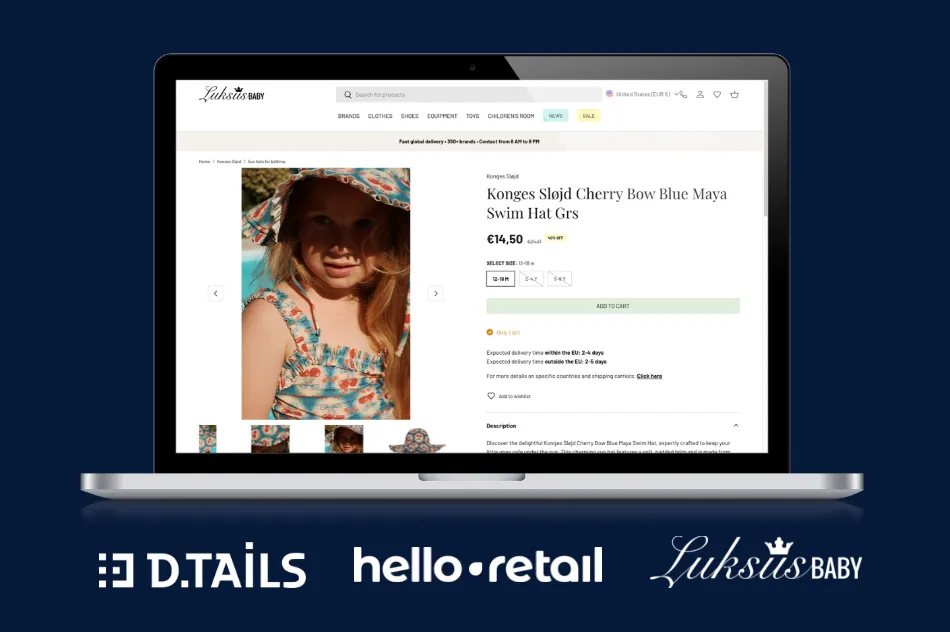
The most detailed public record of DTAILS and Hello Retail working together is the Luksusbaby migration.
Luksusbaby is a premium Danish retailer for children’s fashion and accessories, with operations across multiple international markets. DTAILS led the migration of six Luksusbaby storefronts from DanDomain to Shopify Plus. Once the Shopify Plus foundation was in place, Hello Retail handled search, filtering, and product recommendations across those storefronts.
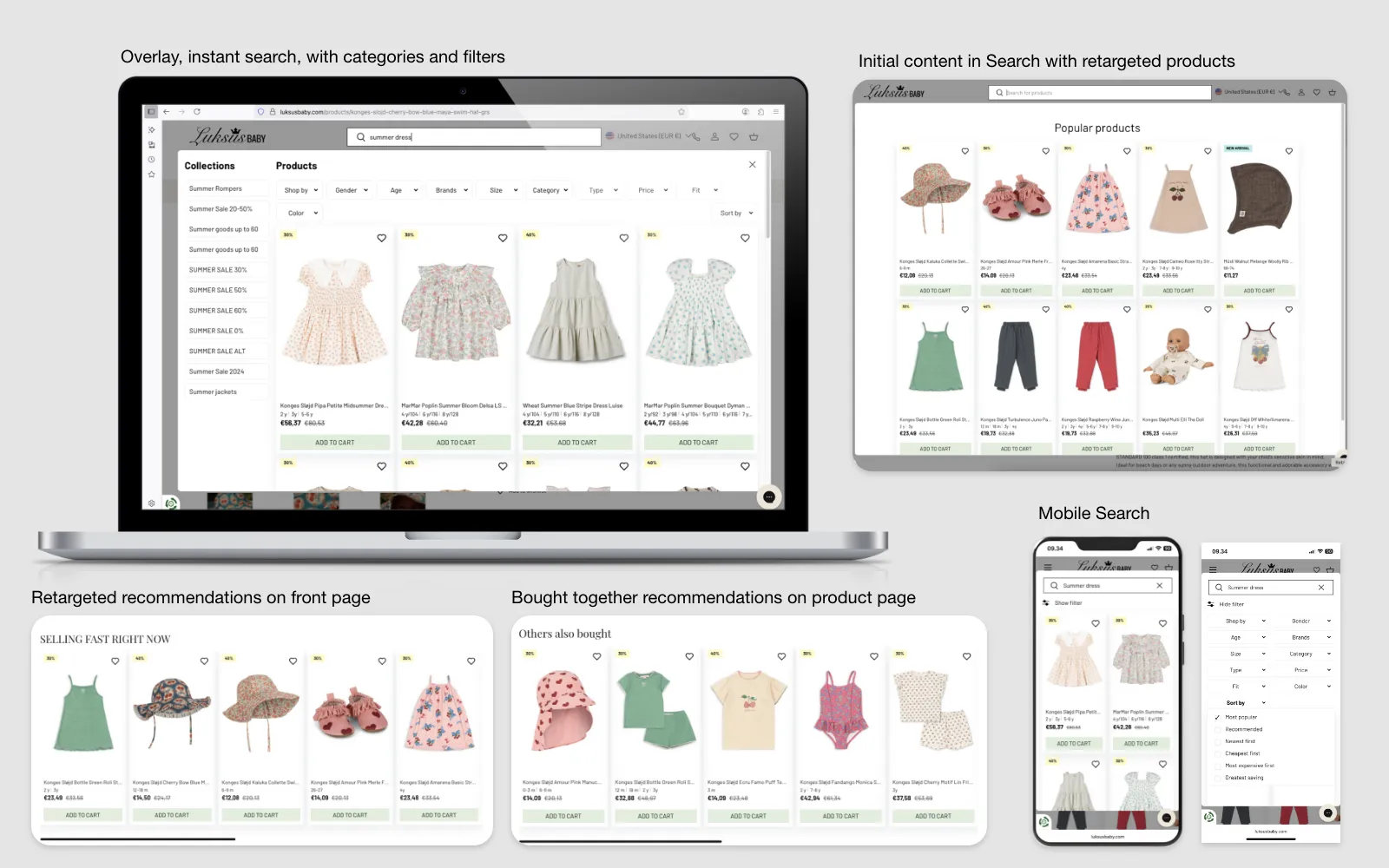
The division of responsibility reflects a clear technical logic. Shopify Plus provided the commerce infrastructure: centralized backend, multi-market management, flexible storefront delivery per language and currency. Hello Retail’s Search added the intelligence layer: typo-tolerant, behaviorally personalized on-site search with advanced filtering that matches how Luksusbaby’s shoppers actually type queries rather than how the product catalog happens to be tagged.
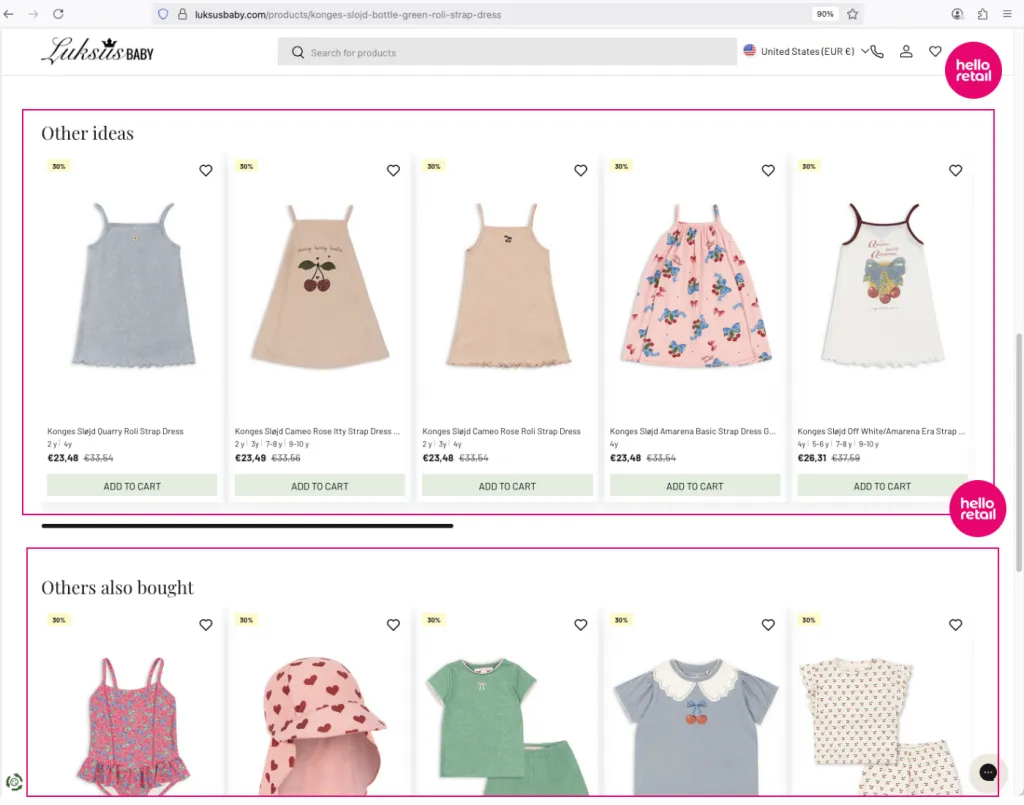
Hello Retail’s Product Recommendations completed the personalization layer: dynamically ranked product suggestions on category pages, product detail pages, and the homepage, based on each shopper’s behavioral signals accumulated within the session and across prior visits.

The rollout was deliberately sequenced. DTAILS migrated smaller markets first, starting with Korea, to contain exposure during the transition. Hello Retail integrations were deployed once the Shopify Plus infrastructure was stable. The three-party project team (Luksusbaby, DTAILS, Hello Retail) operated with direct communication across all three, removing the relay delays that slow down multi-vendor projects.
Why the combination fits
Peter Sommer’s observations on when merchants outgrow native Shopify search are operationally precise. Two conditions surface consistently.
The first is language handling: the gap between how customers type queries and how products are tagged grows visible as catalog maturity increases. Synonyms, misspellings, attribute-based queries (“warm jacket for hiking”), and intent gaps require handling that keyword matching cannot deliver at scale.
The second is catalog size: large assortments expose ranking and relevance limitations faster, and the cost of manual curation scales with the catalog. Automated, behaviorally informed recommendations eliminate much of that overhead once the behavioral data reaches sufficient volume.
“The larger the customers are, the bigger their product assortment is, and the further up they are in their advancement of being a mature e-commerce merchant, the more you need tools like Hello Retail to fit the needs of their customers.”
Peter Sommer, CEO
That pattern holds across the 9+ joint clients DTAILS and Hello Retail share. Merchants at a certain scale, typically mid-market merchants with substantial catalogs operating in more than one market, reach a point where the default platform tooling returns results that are technically correct but commercially wrong. That is the inflection point where the DTAILS and Hello Retail stack answers the practical question rather than the theoretical one.
Peter Sommer
CEO · DTAILS
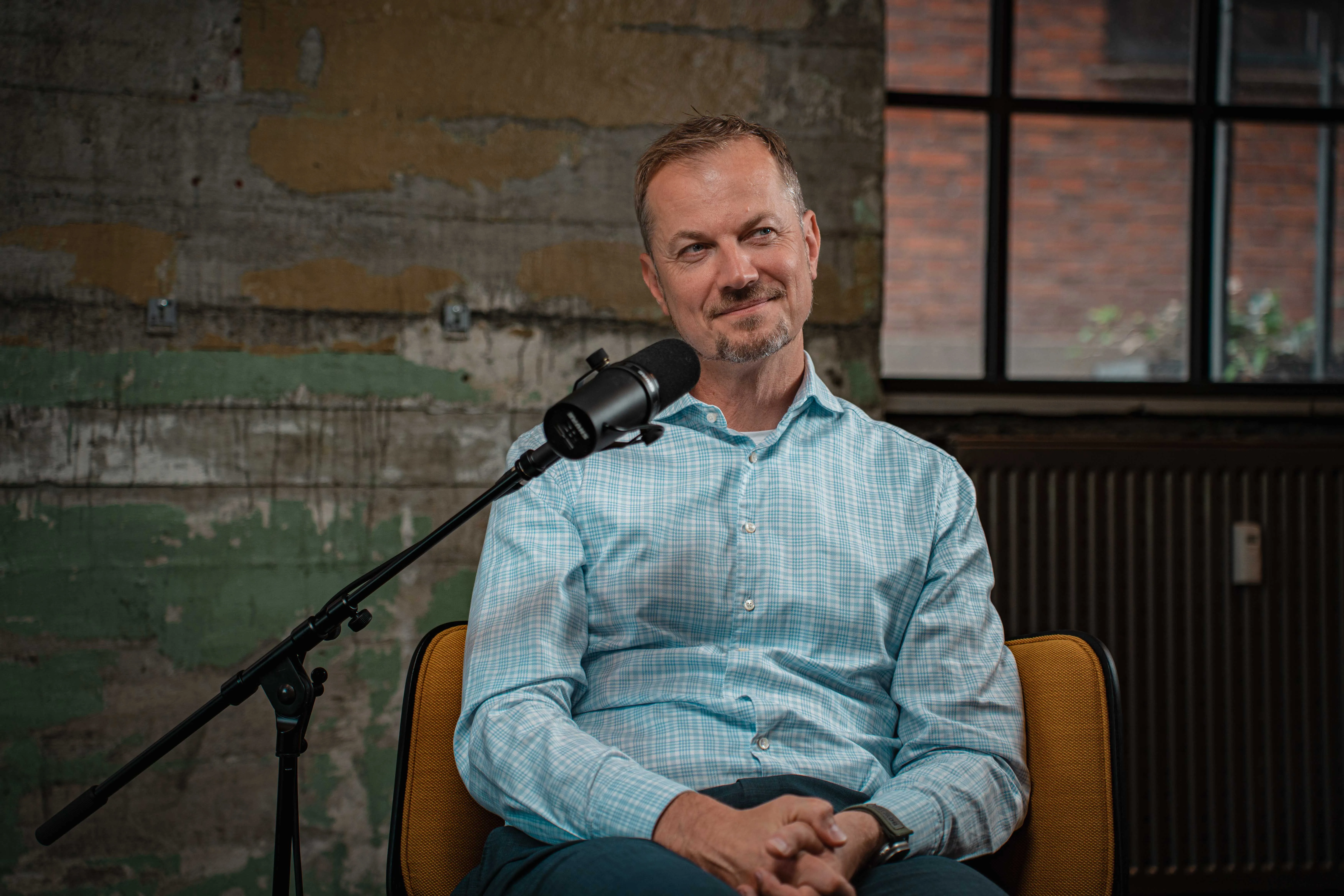
Peter Sommer is the CEO of DTAILS. Before joining, he spent four years as a Partner in IBM's consulting division. We sat down with him to talk about what drives merchants off legacy platforms, AI-powered translation at scale, and why agentic commerce is already live for Shopify merchants in North America.
Working with DTAILS
DTAILS is currently taking on new client work. Their primary fit: Shopify merchants above €3M GMV considering a platform migration, Nordic mid-market merchants running both B2B and DTC operations and needing those on a unified stack, and clients who need Klaviyo and Hello Retail wired into a Shopify Plus build from day one rather than retrofitted later.
Their full case study archive, including the Luksusbaby migration in detail, is at dtails.dk/en.
For merchants considering both a Shopify Plus migration and a personalization layer upgrade, speak to Hello Retail about how the joint onboarding process is structured and what integration looks like in practice.
Keep reading
 Solutions
 Shopify B2B is on every plan. What about personalization?
Shopify B2B is now on every plan. Personalization can go further - here's how to handle search, recommendations, and replenishment for wholesale buyers.
 Conversations
 A shoe comes back: Monica Trabjerg Balle on recommerce as a revenue channel
Monica Trabjerg Balle was Head of ecommerce at Roccamore when take-back came onto her radar as a commercial question. As former CCO at Create2Stay, she built circular commerce for 30+ brands. The numbers: 42% new customer acquisition, half the return rate of new products.
 Conversations
 Shopping beyond the website: Peter Sommer on Shopify's growth, AI translation, and agentic commerce
Peter Sommer has been a Shopify Plus partner since 2016. In this conversation, he covers what drives merchants off legacy platforms, how AI made a 25-year content library translatable in a month, and why the LLM advisory phase will reshape ecommerce before the checkout does.