
Current email-marketing pain points: Why relevance is the missing piece
Email inboxes are crowded. Shoppers receive dozens of marketing messages every day, and most are either ignored or prompt an unsubscribe. For ecommerce brands, the core pain point is relevance: sending emails that feel generic wastes budget and erodes list health. The challenge is producing consistently relevant content - confirmation emails, welcome flows, campaigns, and newsletters - without the manual effort that true personalization at scale typically demands.
The scale of the inbox problem
Global email volume has reached a point where standing out is genuinely hard. According to Statista, over 347 billion emails were sent and received every single day in 2023, a number that continues to climb year on year. For any individual shopper, that translates to an inbox that has become a permanent sorting task.
Ecommerce brands feel this on both sides. Sending more emails is often the reflex - more seasonal campaigns, more segmented blasts, more promotional pushes around key dates. But volume alone doesn’t drive engagement. When a subscriber sees a subject line that looks identical to the last fifteen they received, the delete key wins - or worse, the unsubscribe button does.
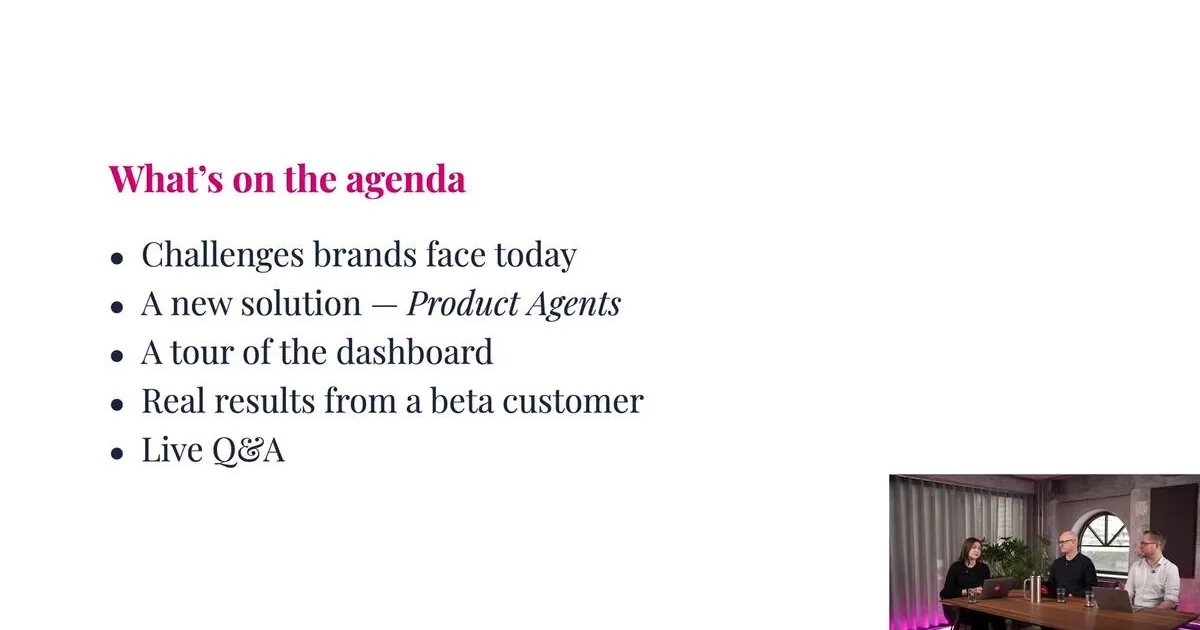
The opening chapter of Hello Retail’s Product Agents webinar frames the problem exactly this way. Most ecommerce teams already deal with email every day: confirmation messages, welcome sequences, ongoing campaigns, regular newsletters. The question isn’t whether they’re sending. The question is whether those emails are landing with the right person, at the right moment, with the right product.
When irrelevance damages more than a single send
The business cost of an irrelevant email extends well beyond one unopened message. Unsubscribes are the visible signal, but the damage accumulates in less obvious ways. Inbox providers - Gmail, Outlook, Apple Mail - use engagement signals to determine future placement. A consistent pattern of low open rates and high “delete without reading” actions gradually pushes a sender’s domain into the promotions tab or, eventually, the spam folder. The brand never receives a notification. Reach just quietly shrinks.
Litmus puts the average email marketing return on investment at $36 for every $1 spent - but that figure assumes deliverability. An email that never reaches the primary inbox returns nothing, and the cost of rebuilding sender reputation after a deliverability slide is significant.
The compounding irony is that most brands respond to falling engagement by sending more, not less. Seasonal campaigns stack on top of automated flows, which stack on top of re-engagement sequences. Without a relevance layer governing what actually goes out, every additional send risks dragging deliverability down further.
The personalization vs. effort trade-off
Relevance, in practice, means personalization: surfacing products and content that reflect each subscriber’s individual interests and behavior rather than their membership in a broad segment. The problem is that genuine per-subscriber personalization has traditionally required significant manual effort. Curating product selections, building behavioral segments, writing copy variations, setting up tests - for a team managing a catalog of tens of thousands of SKUs and a list of hundreds of thousands of subscribers, that’s an impossible workload, not a scaling challenge.
The result is that most brands compromise. They settle for audience-level segments - “women who purchased in the last 90 days,” “subscribers who clicked last month” - rather than individual relevance. These segments are better than nothing, but they fall well short of what shoppers now expect.
Epsilon research found that 80% of consumers are more likely to make a purchase when a brand offers a personalized experience. The gap between that expectation and what most email programs actually deliver is wide, and it’s been widening as major platforms raise the baseline of what “relevant” looks like in a consumer’s inbox.
What relevant email actually requires
Relevance connects product data to individual shopper behavior. A shopper who browsed running shoes three times in a week should receive something very different from a shopper who last bought a winter coat six months ago. The email template may look identical - same header, same layout, same call to action - but the products carrying it need to be doing completely different jobs for those two people.
This is the logic behind Hello Retail Product Agents, which fire automated, product-aware messages built on the same Product Intelligence model used by Search and Recommendations across the storefront. The agent’s underlying model identifies how items relate to one another, which products customers tend to buy in sequence, and how long gaps typically fall between purchases. The same principle extends to scheduled sends through Newsletter Content, which generates personalized product blocks for individual subscribers, designed to embed within an existing ESP workflow without requiring the team to rebuild how they send.
Both surfaces address the same underlying tension the webinar opens with: email teams aren’t short of things to send. They’re short of the infrastructure to make every send feel individually relevant without expanding headcount to match.
Salesforce’s State of the Connected Customer found that 73% of customers expect brands to understand their unique needs and expectations. When email programs fall short of that bar, shoppers don’t typically complain. They just stop opening.
Fewer unopens start with better inputs
Solving the email relevance problem isn’t primarily about sending less - it’s about sending with better inputs. When the product selection in each email reflects what a given shopper actually wants, the metrics shift: open rates improve because the subject line references something real to that subscriber; click rates improve because the featured product matches demonstrated interest; unsubscribe rates fall because the inbox relationship starts to feel useful rather than noisy.
The opening of the Product Agents webinar establishes this as the problem worth solving. The session’s subsequent chapters introduce how automated product intelligence tackles the relevance layer at scale, removing the manual curation effort from the email team while keeping every message grounded in individual shopper behavior. If you want to see how that works in practice, the full webinar walks through the Product Agents dashboard and early beta results in detail.
Keep reading
Solutions Current email-marketing pain points: Why relevance is the missing piece
Email inboxes are crowded and most marketing messages go ignored or trigger unsubscribes, making relevance the core email-marketing pain point for ecommerce brands.
 Solutions
 Product Agents explained: Types and automated emails
Product Agents combine behavioral data and Product Intelligence to schedule automated, personalized emails across post-conversion, replenishment, and price drop scenarios.
 Solutions
 Inside the Product Agents dashboard: Management, control, and results
The Hello Retail Product Agents dashboard gives teams a single surface to manage automated email agents, review scheduled sends, and track every generated email.