
Chapter: Big Picture & AI Data Advantage · 1:46
The big picture: AI data advantage for ecommerce marketing
Hello Retail’s overarching promise - helping ecommerce teams run better stores - carries real weight: decades of ecommerce experience, behavioral data at scale, and AI capability baked into every product and every customer-success conversation. The catalyst for the company’s latest product launch is a sharp rise in customer acquisition costs, documented across the industry, and a growing recognition among marketing teams that AI has shifted from optional tool to operational baseline.
The acquisition cost problem
Rising customer acquisition costs have become the defining pressure on ecommerce marketing budgets. Klaviyo’s 2025 State of Marketing report shows the cost of winning new customers has climbed sharply, with paid media efficiency declining as competition for digital ad inventory intensifies. That is the specific backdrop Hello Retail is responding to with its latest product launch.
The underlying economics have always been uncomfortable. Research from Bain & Company, cited in Harvard Business Review, shows that acquiring a new customer costs 5 to 25 times more than retaining an existing one. When acquisition costs climb further on top of that baseline, the case for investing in retention and repeat purchase grows harder to ignore. These are the levers where data-driven ecommerce tools deliver their clearest return - and where Hello Retail has spent years building capability.
Hello Retail’s framing here is deliberate: technology alone is not enough. What makes a durable response is the combination of the right data, AI models trained specifically on ecommerce behavior, and the operational depth to translate signals into store improvements that compound over time.
AI dependency and the pressure to act
The same Klaviyo report captures a second dynamic running alongside rising acquisition costs: many marketing teams say they can no longer do their jobs efficiently without AI tools. That observation has two layers. It reflects how quickly AI has moved from experiment to infrastructure for a growing segment of ecommerce operators. It also captures the pressure felt by teams that haven’t yet made that transition - the sense that they’re falling behind while they’re still evaluating where to start.
McKinsey’s 2024 State of AI survey found that 72% of organizations now use AI in at least one business function, roughly double the adoption rate from a few years prior. The direction is clear. What is less clear for many ecommerce teams is how to move from selective AI use to something systematic - something that addresses actual operational pressure from the ground up.
This is the gap Hello Retail is positioning itself to close. The challenge is giving ecommerce teams a pragmatic path to deploy AI on the specific problems they face: rising acquisition costs, thinning margins, and the overhead of running personalized experiences without a dedicated data science team.
Hello Retail’s data advantage
What distinguishes Hello Retail’s approach is the scale and specificity of its data. Years of operating across a wide range of ecommerce stores have produced a behavioral dataset that individual retailers could rarely assemble on their own. Product views, search queries, purchase sequences, browse patterns, cart events - aggregated and refined at a scale that lets AI models identify patterns invisible from a single-store perspective.
That data foundation reaches beyond improving recommendation relevance. It informs timing models, relevance scoring, and the behavioral triggers that power campaigns like abandoned-cart and browse-abandonment flows. The AI starts informed rather than cold - trained on years of ecommerce-specific signal, which means it begins with meaningful context and improves faster than a model starting from scratch.
Epsilon’s “Power of Me” research found that 80% of consumers are more likely to purchase from a brand that provides personalized experiences. That figure explains the value of Hello Retail’s underlying data infrastructure: behavioral personalization at scale is a genuine competitive advantage, but only if the data feeding it is rich enough and specific enough to drive real relevance. Generic personalization built on thin signals tends to disappoint both merchants and shoppers.
Hello Retail’s argument is that its dataset - trained on actual ecommerce behavior across many store types and customer journeys - is what makes meaningful personalization viable even for mid-sized retailers without in-house AI teams.
Experience that comes built in
There is another dimension to Hello Retail’s promise that is easy to miss from the outside: the consulting and best-practices layer wrapped around the technology. The customer success team brings decades of ecommerce operating experience across different verticals and growth stages. When a new product ships, that experience is embedded in the product defaults, the configuration workflows, and the support structures - carried into the product rather than left as an exercise for the customer.
For ecommerce teams stretched thin across acquisition, retention, merchandising, and operations, this matters. AI tools that require extensive internal calibration before they produce results are a liability for teams without the bandwidth to manage them. Hello Retail’s model is different in character: AI that starts from an informed position and gets more precise over time, with a support layer built around it from day one.
What this chapter sets up
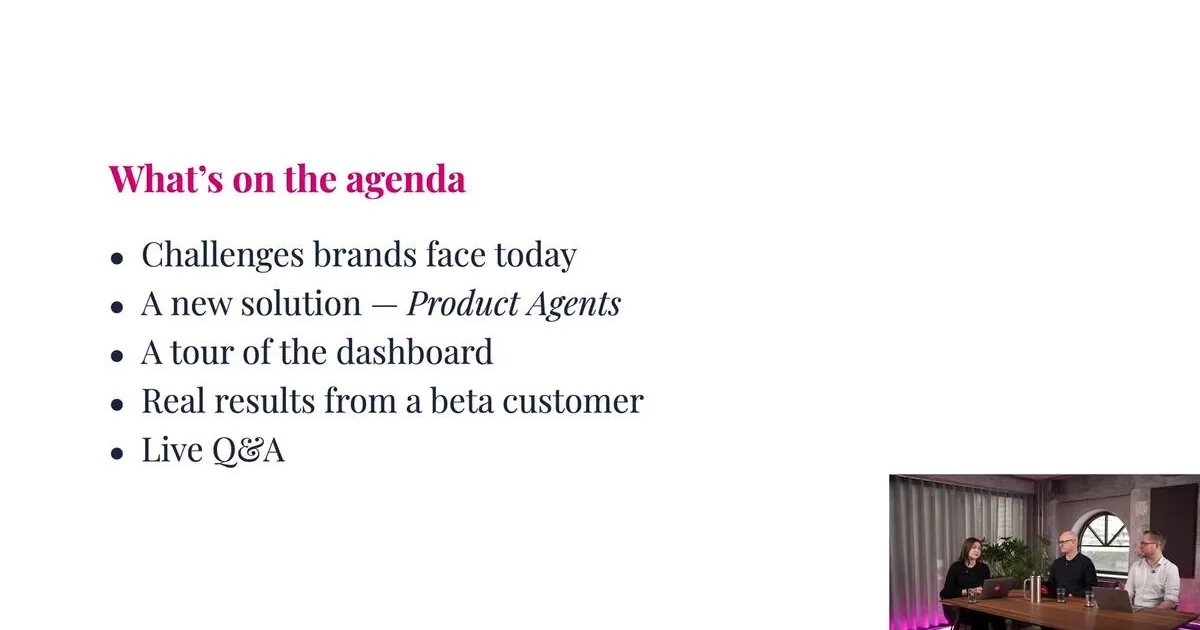
This opening chapter of the product launch webinar is framing, not product. The specific capabilities being launched are covered in the sessions that follow - the agents, the models, the dashboard, the measured results. But the reasoning behind the launch is clear from this chapter alone: a documented business problem (sharply rising acquisition costs, growing AI adoption pressure), a genuine asset to meet it with (years of behavioral data, AI built specifically for ecommerce), and a philosophy that combines technology with the operational experience to make it work in practice.
The question most ecommerce teams are already asking is: why now, and why Hello Retail? This chapter is the answer.
Keep reading
 Solutions
Banner creation demo: Building retail media campaigns with the inspiration catalog
Hello Retail's Retail Media banner creator builds and launches on-site campaigns in minutes, with AI imagery, multi-size output, and an inspiration catalog of ready-made use cases.
 Solutions
Current email-marketing pain points: Why relevance is the missing piece
Email inboxes are crowded and most marketing messages go ignored or trigger unsubscribes, making relevance the core email-marketing pain point for ecommerce brands.